
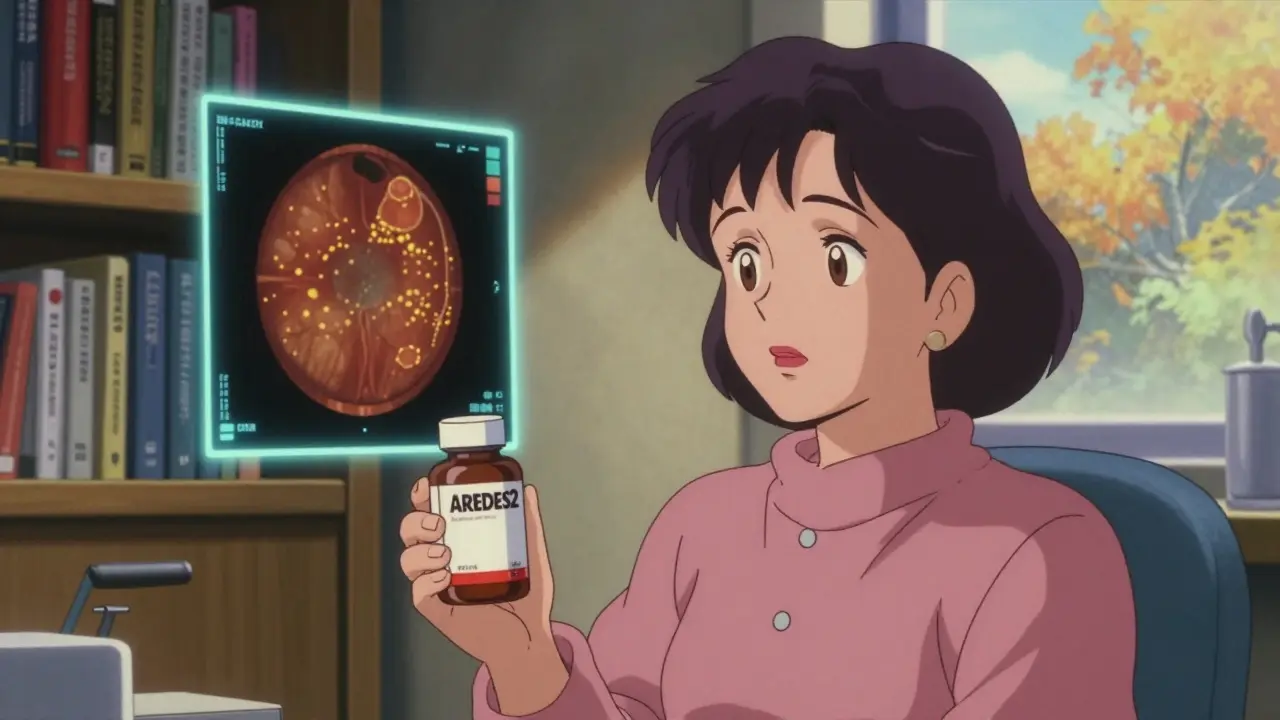
If you’ve been told you have age-related macular degeneration (AMD), you’ve probably heard about AREDS2 vitamins. But do they actually work? And more importantly - are they right for you? The answer isn’t simple. Millions of people take these supplements hoping to save their vision. Some do. Many don’t. The difference lies in one thing: stage of disease.
What AREDS2 Vitamins Actually Are
The AREDS2 formula isn’t just another multivitamin. It’s a specific, clinically tested combination of nutrients designed for one purpose: to slow the progression of intermediate to advanced dry AMD. It’s not a cure. It won’t restore lost vision. And it won’t help if you don’t have the right stage of the disease.
The formula contains six ingredients in precise doses:
- 500 mg vitamin C
- 400 IU vitamin E
- 10 mg lutein
- 2 mg zeaxanthin
- 80 mg zinc (as zinc oxide)
- 2 mg copper (as cupric oxide)
This combination was finalized after the Age-Related Eye Disease Study 2 - a 12-year, $70 million clinical trial led by the National Eye Institute. The study tracked over 3,800 people with AMD, comparing different versions of the original AREDS formula. The big change? They swapped out beta carotene for lutein and zeaxanthin.
Why Beta Carotene Was Removed
Early versions of the supplement included 15 mg of beta carotene - a nutrient found in carrots and sweet potatoes. But researchers found a dangerous side effect: in current and former smokers, beta carotene increased lung cancer risk by about 20%. That’s not a small trade-off. Losing vision is serious. But losing your lungs to cancer? That’s life-threatening.
The AREDS2 trial proved that lutein and zeaxanthin - two plant pigments found in spinach, kale, and egg yolks - were not only safer but more effective. People taking lutein and zeaxanthin had an 18% better reduction in AMD progression than those on beta carotene. By the 10-year follow-up published in JAMA Ophthalmology in 2022, the lutein/zeaxanthin group showed a 26% lower risk of advancing to late-stage AMD compared to those on the original formula.
Who Should Take AREDS2 Vitamins?
This is where most people get it wrong. AREDS2 supplements are not for everyone with eye problems.
They’re only recommended if you have:
- Intermediate AMD in one or both eyes - meaning lots of medium-sized drusen (yellow deposits under the retina), or at least one large drusen
- Or advanced AMD (geographic atrophy) in one eye, with intermediate AMD in the other
If you have early AMD - just a few small drusen - taking these vitamins won’t help. A 2023 analysis from Vision-and-Eye-Health.com confirms: “The AREDS2 formula does not offer benefits for individuals with early AMD, nor does it prevent the onset of the condition.”
And if you don’t have AMD at all? Don’t take them. No evidence supports using them as a preventive measure. Taking high-dose zinc and vitamins when you don’t need them can cause side effects - nausea, stomach upset, or even copper deficiency over time.

What About Late-Stage AMD?
For years, doctors said AREDS2 supplements didn’t help once AMD reached the late stage - when large areas of the retina have died off (geographic atrophy). That changed in July 2024.
Researchers analyzed retinal scans from 1,209 participants in the original AREDS2 study. They found that those taking the supplement had a 55% slower rate of geographic atrophy growth over three years - if the damaged area was outside the very center of the macula (the fovea).
This is huge. For people with late-stage dry AMD, this could mean keeping enough vision to read, recognize faces, or walk safely without help. Geraldine Hoad of the Macular Society called it “encouraging for people with GA.”
But here’s the catch: the benefit was only clear when the damage wasn’t in the central vision zone. If your central vision is already gone, the supplement won’t bring it back. And the study wasn’t a controlled trial - it was a re-analysis of old data. More research is needed. Still, it’s the first real sign that AREDS2 might help even after the disease has advanced.
What Doesn’t Work
The AREDS2 team tested other ideas too - and some surprises came out.
Omega-3 fatty acids (fish oil)? No benefit. Adding them to the formula didn’t slow AMD any further.
B vitamins? They looked promising in early studies, but AREDS2 showed no effect on progression.
And don’t be fooled by “AREDS2-style” supplements sold online. Many brands change the doses. Some cut the zinc. Others add extra herbs or antioxidants. But the science only backs the exact formula: 500 mg vitamin C, 400 IU vitamin E, 10 mg lutein, 2 mg zeaxanthin, 80 mg zinc, 2 mg copper.
If you’re buying over the counter, check the label. If it doesn’t match those numbers exactly, it’s not the same thing.
Long-Term Safety
People often worry about taking high-dose supplements for years. The good news? The 10-year follow-up found no major safety issues. Zinc levels stayed stable. No increase in prostate cancer, as some feared. No kidney damage. No liver problems.
Copper was added specifically to prevent zinc-induced copper deficiency - a real risk at high doses. So if a supplement has zinc but no copper, it’s incomplete and potentially harmful.
Side effects are rare but possible: mild stomach upset, especially with zinc. Taking the pills with food helps. Some people report yellowing of the skin from lutein - harmless, but noticeable.
What to Do Next
If you’ve been diagnosed with AMD, your first step isn’t to run to the pharmacy. It’s to see your eye doctor.
They’ll examine your retina, measure your drusen, and determine your stage. If you have intermediate AMD or advanced AMD in one eye with intermediate in the other, they’ll likely recommend AREDS2.
If you’re a former smoker, make sure your supplement has lutein and zeaxanthin - not beta carotene. If you’re still smoking, talk to your doctor about quitting before starting any supplements.
And if you’re healthy with no signs of AMD? Focus on diet. Eat leafy greens. Have eggs. Wear sunglasses outdoors. These are proven, safe ways to protect your eyes - no pills needed.
Realistic Expectations
Dr. Emily Chew, who led the AREDS2 studies, says it plainly: “AREDS supplements cannot reverse vision damage that has already occurred.”
They don’t stop AMD. They don’t restore vision. They just slow it down - sometimes by a few years. That might mean you keep driving for another 2-3 years. Or you keep reading your grandchild’s school letters without needing a magnifier.
For many, that’s worth it. But it’s not magic. It’s science. And science only works if you’re in the right group.
Do AREDS2 vitamins cure AMD?
No. AREDS2 vitamins cannot reverse or cure any vision loss caused by AMD. They only slow the progression of the disease in people with intermediate or advanced dry AMD. Once central vision is lost, the supplements won’t bring it back.
Can I take AREDS2 vitamins if I have early AMD?
No. Multiple studies, including the 10-year AREDS2 follow-up, show no benefit for people with early AMD - defined by only small drusen. Taking the supplement won’t prevent progression and may expose you to unnecessary side effects from high-dose zinc.
Is it safe to take AREDS2 vitamins long-term?
Yes. The 10-year follow-up study found no significant safety issues in people who took the formula daily. Zinc and copper levels remained stable, and there was no increase in serious conditions like cancer or kidney disease. Always take the version with copper to avoid copper deficiency.
Can I get the same benefits from food instead of pills?
It’s very hard. The doses in AREDS2 are much higher than what you’d get from diet alone. You’d need to eat over 2 cups of cooked kale daily to match the lutein dose. That’s not realistic for most people. Supplements are designed to deliver precise, concentrated doses that food alone can’t provide.
Do I need to take AREDS2 vitamins forever?
There’s no set end date. Most people continue taking them as long as their eye doctor recommends. The benefits appear to last over time, and stopping abruptly could allow progression to resume. Always consult your doctor before stopping or changing your regimen.
Are all AREDS2 supplements the same?
No. Many brands use different doses or substitute ingredients. Only supplements that match the exact AREDS2 formula - 500 mg vitamin C, 400 IU vitamin E, 10 mg lutein, 2 mg zeaxanthin, 80 mg zinc, 2 mg copper - have been proven effective. Always check the label. If it’s missing copper or has less zinc, it’s not the same.


Hilary Miller
January 21, 2026 AT 18:16Just took my AREDS2 pills with breakfast. No more random eye drops. Just science. 🙌
shivani acharya
January 22, 2026 AT 05:56Okay but let’s be real - who’s really behind this? Big Pharma knows people will swallow anything if it’s labeled ‘clinically proven.’ I mean, why did they swap beta carotene? Was it really about lung cancer… or because they could sell lutein at 500% markup? I’ve seen the same ‘miracle’ formula pop up in 17 different brands with different names. Someone’s making bank off our fear of going blind. And don’t even get me started on the copper. Why do they even include it? To make us feel better? Or because the zinc would literally eat our insides if we didn’t? 🤔
Sarvesh CK
January 23, 2026 AT 17:22It’s fascinating how medicine often operates in thresholds - not absolutes. The AREDS2 formula doesn’t promise restoration, only mitigation. This reflects a broader truth in chronic disease management: we are not seeking cures, but time. Time to read a grandchild’s letter. Time to recognize a face. Time to retain autonomy. The science here is not flashy, but it is deeply human. We must be cautious not to confuse efficacy with expectation. The supplement’s value lies not in its power to reverse, but in its quiet capacity to delay - a gift in an age where every year of independence is a victory.
Alec Amiri
January 23, 2026 AT 20:35LMAO so you’re telling me I spent $40 a month on fish oil for years thinking it’d save my eyes? Bro. I’m not mad, I’m just disappointed. Like, I could’ve been buying tacos instead. And now I gotta buy this exact combo? What if I accidentally get 78mg zinc instead of 80? Does my vision just vanish? 😭
arun mehta
January 24, 2026 AT 07:36Thank you for this meticulously researched piece. 🙏 The clarity with which you’ve delineated the stages of AMD and the precise indications for AREDS2 is both rare and invaluable. Many patients, myself included, have been misled by well-meaning but misinformed influencers who promote supplements as universal panaceas. The data is unequivocal: intervention must be stage-specific. To those who ask, ‘Can’t I just take it for prevention?’ - the answer is not merely ‘no,’ but ‘dangerously unwise.’ Your emphasis on the copper-zinc balance is particularly critical. Many over-the-counter formulations omit copper, creating a biochemical imbalance that may, over time, induce neurological complications. Please, always verify the label. Your eyes deserve nothing less than precision.
Patrick Roth
January 25, 2026 AT 10:52Wait, so you’re saying the government spent $70 million just to prove that taking pills doesn’t fix your eyes? What a waste. I’ve been eating raw kale and staring at the sun since 2018. My vision’s perfect. You guys are just scared of natural healing. Also, why is zinc oxide in there? That’s paint pigment. Are we supposed to be eating primer now? 🤨
Lauren Wall
January 26, 2026 AT 16:22If you don’t have intermediate AMD, you’re just wasting money and poisoning yourself. Stop being lazy and eat your greens.
Tatiana Bandurina
January 28, 2026 AT 10:20I’ve been taking AREDS2 for 7 years. My doctor said I’m a candidate. But I started noticing my skin turning yellow. Not just a little - like, I look like I’ve been dipped in turmeric. I Googled it. Turns out lutein does that. No one warned me. I’m not even sure if I should keep taking it. I mean, I don’t want to go blind, but I also don’t want to look like a cartoon.
Philip House
January 29, 2026 AT 08:19Look, I get it. Science says this works for some people. But let’s be honest - America’s obsession with pills is ridiculous. In China, they just eat spinach. In India, they use turmeric. In Greece, they eat olive oil. We’re the ones who turn every eye problem into a pharmaceutical product. We don’t fix diets. We don’t fix sunlight exposure. We just slap a bottle on the shelf and call it progress. This isn’t medicine. It’s capitalism with a stethoscope.
Mike P
January 30, 2026 AT 18:23My grandma took these for 10 years. Still went blind. So what’s the point? You’re just buying time and paying for it. And the label? Half the time it’s wrong. I bought a ‘real’ AREDS2 once and it had 50mg zinc. What’s that even called? AREDS1.5? I’m not dumb. I know they’re milking this. But my mom’s crying in the dark and I don’t know what else to do. So I keep buying it. Even if it’s a lie.
Jasmine Bryant
January 31, 2026 AT 06:30wait so if i have early amd and take these anyway... is it just useless or actually harmful? i think i might have taken them for a year already 😬
Brenda King
January 31, 2026 AT 08:12My ophthalmologist said I’m a perfect candidate - intermediate AMD in both eyes. I’ve been on AREDS2 for 18 months. My drusen haven’t grown. I don’t know if it’s the pills or just luck, but I’m not taking any chances. I eat spinach every day too. And I wear my sunglasses like they’re armor. This isn’t about miracles. It’s about showing up. Every day. Even when it feels pointless.
Malik Ronquillo
January 31, 2026 AT 21:11So basically you’re saying if you’re not rich enough to buy the exact pill with the exact numbers, you’re doomed? What a joke. My cousin in Mexico takes generic stuff and he’s still driving at 82. You guys are scared of life, not macular degeneration.
Margaret Khaemba
January 31, 2026 AT 23:54I’m from Kenya and we don’t have AREDS2 here. But we do have moringa, spinach, and eggs - all rich in lutein. I started making a daily smoothie with them and my mom’s eyes feel better. Maybe the answer isn’t just pills. Maybe it’s food, culture, and community. Just saying.