

Managing diabetes isn’t about cutting out carbs completely. It’s about knowing how much you’re eating and how it affects your blood sugar. That’s where carbohydrate counting comes in. It’s not a diet. It’s not a restriction. It’s a practical tool that lets you eat the foods you like while keeping your glucose levels steady. If you’re just starting out, it might feel overwhelming. But with the right approach, it becomes second nature.
Why Carbohydrate Counting Works
Carbs are the main nutrient that raises your blood sugar. When you eat bread, rice, fruit, or even milk, your body breaks it down into glucose. That glucose enters your bloodstream. If you have diabetes, your body either doesn’t make enough insulin or can’t use it well. Without proper management, that glucose builds up, leading to spikes that can damage your nerves, kidneys, and heart over time.
Carb counting gives you control. Instead of guessing, you measure. You learn how many grams of carbs are in each food. Then you match that to your insulin dose or adjust your meal plan accordingly. The American Diabetes Association says it’s one of the most effective ways to reach your target blood sugar numbers. Studies show people who track their carbs consistently see their HbA1c drop by 0.5% to 1.0% - a meaningful improvement that reduces long-term risks.
What Counts as One Carb Serving?
Most people start with a simple unit: 15 grams of carbohydrates. That’s one serving. Think of it like a measuring cup for carbs. Here’s what one serving looks like in real food:
- 1 slice of bread
- 1 small apple (about the size of a tennis ball)
- 1/2 cup of cooked pasta or rice
- 1/2 cup of beans or corn
- 1 cup of milk or plain yogurt
- 1/3 cup of oatmeal
These aren’t guesses. They’re based on standard nutrition guidelines from the CDC and other health organizations. Once you know what 15 grams looks like, you can start adding up your meals. A bowl of cereal with milk? That’s two servings. A sandwich? That’s two or three, depending on the bread.
How to Read Nutrition Labels
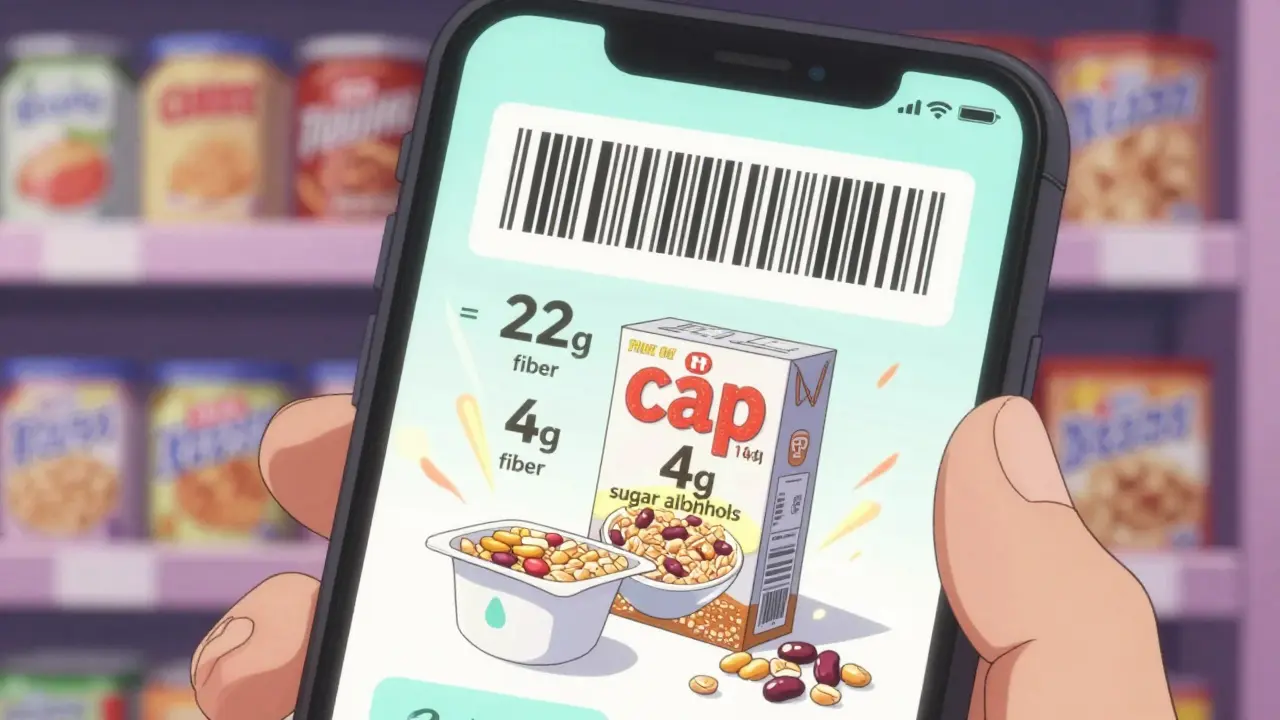
Food labels make this easier. Look for the “Total Carbohydrates” line. That number includes all carbs: sugars, starches, and fiber. You don’t need to add them up yourself - the label does it for you.
But here’s the trick: fiber and sugar alcohols don’t affect blood sugar the same way. If a food has more than 5 grams of fiber, subtract the full amount of fiber from the total carbs. For sugar alcohols (like sorbitol or xylitol), divide the number by two and subtract that from the total. For example:
- Total carbs: 22g
- Fiber: 6g
- Sugar alcohols: 4g
- Net carbs: 22 - 6 - (4 ÷ 2) = 14g
This is called “net carbs.” It’s the number that matters for insulin dosing and blood sugar control. Most diabetes apps and tools now calculate net carbs automatically - but knowing how to do it yourself helps when labels are unclear.
How Many Carbs Should You Eat?
There’s no one-size-fits-all number. Your carb needs depend on your age, weight, activity level, insulin sensitivity, and whether you’re on insulin. But as a general guide:
- Most adults with type 1 diabetes need 150-250 grams of carbs per day.
- That’s roughly 45-65% of total calories.
- For type 2 diabetes, some people do well with 130-180 grams, especially if they’re trying to lose weight.
Your healthcare provider or certified diabetes educator will help you find your personal target. Don’t copy someone else’s plan. Your body responds differently than theirs.
Carb-to-Insulin Ratio: The Key to Precision
If you take insulin, this is where carb counting becomes powerful. You’ll likely have a carb-to-insulin ratio - also called a correction factor. It tells you how much insulin to take for each gram of carbs.
For example:
- A ratio of 1:10 means 1 unit of insulin for every 10 grams of carbs.
- A ratio of 1:5 means 1 unit for every 5 grams - which might be needed for someone who’s very sensitive to insulin.
So if you’re eating 45 grams of carbs and your ratio is 1:10, you’d take 4.5 units of insulin. Most insulin pens let you dose in half-unit increments, so this is doable. Your provider will help you find your ratio. It might change during the day - you may need more insulin at dinner than breakfast because your body is less sensitive to insulin in the evening.
Tools That Make It Easier
You don’t need to be a math whiz. There are tools built for this.
- Food scale: Weighing your food is the most accurate way to start. A $20 kitchen scale makes a big difference.
- Measuring cups and spoons: Use them for rice, pasta, cereal - anything you can’t weigh.
- Apps: MyFitnessPal, Carb Manager, and MySugr let you scan barcodes or search foods. They calculate net carbs automatically.
- Restaurant apps: Most major chains like McDonald’s, Starbucks, and Subway have nutrition info online. Save it on your phone.
One tip: Start by measuring everything for two weeks. Even if you think you’re a good estimator, you’ll be surprised. A 2022 study found that people overestimate carbs in restaurant meals by 20-30%. That’s enough to spike your blood sugar.
Common Mistakes (and How to Avoid Them)
Most beginners make the same errors. Here’s what to watch out for:
- Forgetting hidden carbs: Milk in coffee, yogurt with fruit, sauce on your salad - these add up. About 25% of daily carbs come from unexpected sources.
- Not counting starchy vegetables: Potatoes, corn, peas, and winter squash are carbs, not “just vegetables.”
- Ignoring portion size: A “large” apple might be 30 grams of carbs, not 15. Weigh it.
- Assuming “sugar-free” means carb-free: Sugar-free cookies and candies often have starches and sugar alcohols that still affect blood sugar.
Keep a food diary for the first month. Write down everything you eat, how much, and your blood sugar two hours later. You’ll start to see patterns. That’s how you learn.

Carb Counting vs. Other Methods
You might hear about the plate method or glycemic index. Here’s how carb counting stacks up:
| Method | How It Works | Best For | Limitations |
|---|---|---|---|
| Carb Counting | Measures exact grams of carbs; matches to insulin | People on insulin, especially pump or multiple daily injections | Requires tracking, math, and tools |
| Plate Method | Divides plate into sections: half non-starchy veggies, quarter protein, quarter carbs | People not on insulin, or those new to diabetes | No precise numbers; harder to adjust insulin |
| Glycemic Index (GI) | Focuses on how fast carbs raise blood sugar (low GI = slower rise) | People wanting to avoid spikes | Doesn’t tell you how much to eat; hard to apply to mixed meals |
Carb counting gives you the most control - especially if you use insulin. The plate method is simpler, but if you’re injecting insulin before meals, you need numbers. That’s where carb counting wins.
What to Expect in the First Few Weeks
It takes time. Most people need 4 to 8 weeks to feel confident. In the first week, you’ll feel like you’re doing homework. You’ll weigh food. You’ll look up labels. You’ll calculate. It’s tiring.
By week two, you’ll start recognizing portions. A cup of rice? You’ve seen it enough to know it’s about 45 grams. A banana? You know it’s 27 grams. By week four, you’re estimating restaurant meals with 80% accuracy.
And then - the payoff. One person on Reddit said their post-meal spikes dropped from 250+ to 160-180 within two weeks. That’s not magic. That’s carb counting.
When It’s Not the Right Fit
Carb counting isn’t for everyone. If you have type 2 diabetes and manage it with diet and metformin, you might not need it. You might do fine with portion control or the plate method. If you’re not on insulin, your blood sugar doesn’t change as quickly - so you don’t need the precision.
But if you’re on insulin - even just one shot a day - carb counting helps you avoid highs and lows. It reduces guesswork. It gives you freedom. You can still have pasta night. You can still enjoy dessert. You just need to know how much and how to balance it.
Next Steps
Here’s how to start today:
- Get a food scale and measuring cups.
- Download a carb-tracking app (MyFitnessPal or Carb Manager).
- For three days, write down everything you eat and drink - including snacks and sips.
- Use the app to find the carb count for each item.
- At the end of each day, add up your total carbs.
- Share your log with your diabetes educator or doctor.
You don’t need to be perfect. You just need to be consistent. Over time, your body will thank you.
Can I still eat carbs if I have diabetes?
Yes. Carbs are not the enemy. The goal isn’t to eliminate them - it’s to manage them. Whole grains, fruits, legumes, and starchy vegetables are part of a healthy diet. The key is knowing how much you’re eating and matching it with your insulin or medication. Cutting carbs completely can lead to nutrient gaps and is unnecessary for most people.
Do I need to count carbs if I’m not on insulin?
Not necessarily. If you manage type 2 diabetes with diet, exercise, or oral meds like metformin, you may not need exact carb counting. The plate method or portion control can work well. But if your blood sugar still spikes after meals, tracking carbs can help you identify which foods cause problems - even without insulin.
How accurate are food labels for carb counting?
Most are accurate, but not perfect. The FDA requires labels to list total carbs, but there’s a legal margin of error (up to 20%). Restaurant meals are less reliable - studies show they can be 20-30% higher than labeled. Use labels as a guide, not gospel. When in doubt, measure your portion and use an app with verified data.
What if I eat out and can’t find carb info?
Estimate conservatively. For example, if you order a pasta dish, assume it has 60-70 grams of carbs - not the 40 listed online. Choose grilled proteins with non-starchy veggies and ask for sauces on the side. Keep a food diary of restaurant meals. Over time, you’ll build a mental library of common dishes and their carb content.
Can carb counting help me lose weight?
It can. Many people find that tracking carbs naturally reduces their intake because they become more aware of what they’re eating. It also helps avoid blood sugar spikes and crashes, which can reduce cravings. But weight loss depends on total calories, not just carbs. Pair carb counting with portion control and regular activity for best results.





Natali Shevchenko
March 22, 2026 AT 06:12Carb counting felt like learning a new language at first - one where every slice of bread had a secret code. But after a few weeks of weighing everything, I started noticing patterns. Like how my blood sugar spikes after oatmeal but not after quinoa, even if the labels say they’re similar. It’s not about restriction; it’s about tuning in. My body started whispering what it needed, and I finally stopped fighting it. I used to think diabetes was a life sentence of deprivation. Now I know it’s just a really detailed conversation with myself. And honestly? That’s kind of beautiful.
Johny Prayogi
March 23, 2026 AT 03:35This is the most useful guide I’ve ever read 🙌 I’ve been doing this for 3 years and still learned new stuff - especially the fiber and sugar alcohol math. I just downloaded Carb Manager and scanned my breakfast. 14g net carbs. Perfect. Thanks for making this so damn clear. Now I can actually enjoy pancakes again 😎
Nicole James
March 23, 2026 AT 22:50Wait… so you’re telling me the FDA allows food labels to be off by 20%?? That’s not an error - that’s a conspiracy. Who benefits? Big Pharma? The sugar industry? The apps that sell subscriptions? I’ve been counting carbs for 18 months and my numbers don’t match my glucometer - not once. Coincidence? I think not. They want us dependent. They want us anxious. They want us buying more strips, more apps, more insulin. And you? You’re just… calculating. 😏
Nishan Basnet
March 25, 2026 AT 20:25As someone who grew up eating rice with every meal, this post felt like a lifeline. I used to think diabetes meant giving up my grandmother’s dal and roti - turns out, I just needed to measure it. A quarter cup of cooked rice = 15g. One roti = 25g. Suddenly, I could still have my culture, my flavor, my comfort - just with awareness. No guilt. Just balance. And yes, I use a food scale now. It’s the best $20 I ever spent.
Desiree LaPointe
March 26, 2026 AT 10:32Oh wow. A comprehensive guide. How quaint. You didn’t mention that carb counting is basically just glorified food policing - and that most people who do it obsessively end up with orthorexia. Also, have you considered that maybe the real issue is insulin resistance, not carbs? Or that whole foods don’t come with labels? Or that your ‘net carbs’ calculation is based on industry-funded research? I mean… really? 15g = one serving? Who decided that? A committee in Atlanta? 🤔
matthew runcie
March 27, 2026 AT 16:27Good stuff. I’ve been doing this for a year. Still mess up sometimes. But now I know why. No drama. Just progress.
shannon kozee
March 29, 2026 AT 11:15For beginners: start with one meal. Just breakfast. Measure it. Log it. See the numbers. Then do lunch. You don’t need to do everything at once. Tiny steps.
trudale hampton
March 31, 2026 AT 03:12I used to hate this stuff. Felt like math class. Then I realized I could eat pizza again - if I took the right insulin. Now I’m at my lowest HbA1c in 8 years. No magic. Just consistency. And yeah, I still have dessert. Just less of it. 😊
Shaun Wakashige
April 1, 2026 AT 05:55Yikes. This is a lot. I’ll just stick to keto. 🤷♂️
Paul Cuccurullo
April 2, 2026 AT 12:08This is not merely a guide - it is a profound reorientation toward autonomy in the face of chronic illness. The precision offered by carbohydrate counting is not a burden, but a gift of agency. To measure is to reclaim. To calculate is to honor one’s body. I am moved - truly moved - by the clarity and compassion with which this has been presented.
Solomon Kindie
April 3, 2026 AT 22:42so like i read this whole thing and i think carb counting is kinda dumb tbh i just dont eat sugar and im fine also why do we need to subtract fiber like who even made this up i think its a scam
Allison Priole
April 5, 2026 AT 20:27Okay but have you tried doing this while working full-time and parenting two toddlers? I started this last month and now I’m weighing my kid’s apples because I’m scared I’ll mess up his numbers. I’m not even diabetic - I’m just the snack coordinator. But honestly? It’s weirdly calming. Like, I didn’t know I needed to know exactly how many grams were in a banana until I started doing this. Now I feel like a nutrition ninja. And yes, I still eat cookies. Just… measured cookies.
Casey Tenney
April 7, 2026 AT 00:22If you’re counting carbs, you’re already losing. Just eat real food. No labels. No apps. No math. Just meat, eggs, greens. Done.