
Dry Eye Lubricant Selector
Find the most suitable eye lubricant for your specific dry eye condition. Based on your symptoms, lifestyle, and medications, this tool will recommend the best options with important considerations for effectiveness, cost, and ease of use.
For millions of people, waking up with gritty, burning eyes isn’t just annoying-it’s a daily struggle. Dry eye isn’t just about being a little uncomfortable. It’s about blurred vision during Zoom calls, headaches from squinting at screens, and avoiding bright lights because your eyes feel raw. And if you’re managing dry eye caused by medications-like antihistamines, antidepressants, or blood pressure pills-you know how hard it is to find relief without stopping what’s helping your other conditions.
What’s Really Going On With Your Eyes?
Dry eye isn’t one problem. It’s two: your eyes either don’t make enough tears, or the tears evaporate too fast. About 86% of cases fall into the second category-evaporative dry eye-where the oily layer on top of your tears breaks down. That’s why just adding water isn’t enough. You need to fix the barrier that keeps tears from drying out. The Tear Film & Ocular Surface Society says this condition affects up to half the population in some regions. In the U.S. alone, over 16 million adults are diagnosed. But many more go untreated because they think it’s just "old age" or "too much screen time." It’s not. It’s a medical issue that needs the right tools.Lubricants: Not All Eye Drops Are the Same
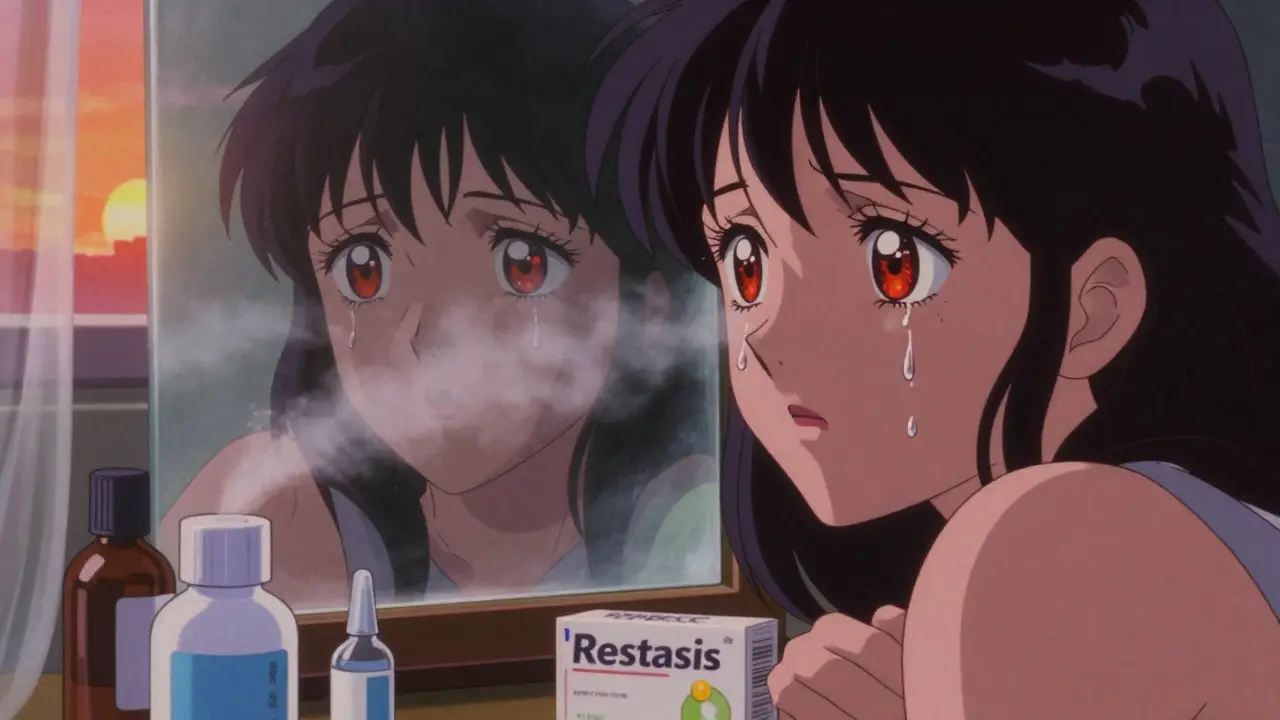
Over-the-counter artificial tears are the first line of defense. But not all of them work the same way. Some are thin, watery drops like Refresh Tears-they give quick relief but last less than two hours. Others, like Refresh Celluvisc, are thick gels that blur your vision for a few minutes but hold moisture for 4 to 6 hours. If you’re using them during the day, go with low-viscosity. At night, a thicker formula helps prevent overnight drying. But if OTC drops aren’t cutting it, you’re probably looking at prescription options. Here’s what’s actually out there:- Restasis (cyclosporine 0.05%): This isn’t a tear replacer. It’s an anti-inflammatory that tells your tear glands to start working again. But it takes 3 to 6 months to show results. Many people quit before they see benefits because of the burning sensation-68% of negative reviews mention this. Refrigerating the bottle helps reduce the sting.
- Xiidra (lifitegrast 5%): Works faster than Restasis. People report feeling better in as little as two weeks. But 25% say it stings every time they use it. That’s why some switch to Restasis after a month, or use them together.
- Miebo (perfluorohexyloctane 3.5%): Approved in 2023, this is the first drop designed specifically to replace the missing oil layer. It doesn’t get absorbed. It sits on top like a shield. Users report immediate relief. In clinical trials, it improved dryness symptoms 1.5 times more than placebo within two weeks. Only 0.16% of users quit because of side effects. The catch? It costs about $650 for a 30-day supply. Insurance often requires you to try cheaper options first.
- Eysuvis (loteprednol etabonate 0.25%): A short-term steroid option for flare-ups. Used for up to 10 days, it reduces redness and swelling fast. Not for daily use.
- Tyrvaya (varenicline nasal spray): Sounds weird, but it works. You spray it in your nose twice a day. It triggers nerves that tell your eyes to make more tears. Costs around $200 a month. No eye drops means no stinging-but some get a sore throat or sneeze.
Generic cyclosporine is now available for $150-$250 a month-down from $500-$600 for the brand. That’s made a big difference for people on tight budgets. Still, 58% of negative reviews on Amazon and Drugs.com mention cost as the main reason they stop treatment.
How to Use Eye Drops Right (So They Actually Work)
Using drops wrong is one of the biggest reasons they fail. Here’s what most people get wrong-and how to fix it:- Don’t let the bottle touch your eye. Even a tiny bit of contamination can cause infections.
- Wait 5 minutes between drops. If you’re using more than one type, don’t dump them in back-to-back. Your eye can’t hold more than one drop at a time. The rest just runs out.
- Close your eyes for 30 seconds after applying. This helps the medicine soak in instead of draining away through your tear ducts.
- Use punctal plugs if needed. These tiny silicone or collagen plugs block the drainage holes in your eyelids. They keep drops-and your natural tears-on the eye longer. Done in-office, they’re cheap and effective.
- Remove contacts before Miebo. You must wait 30 minutes after using Miebo before putting contacts back in. For other drops, 10-15 minutes is enough.
Only 52% of people using Restasis take it twice a day after six months. Why? The burning makes them skip doses. But if you miss doses, you’ll never get the long-term benefit. That’s why some people switch to Miebo for immediate relief and keep Restasis for maintenance.

Humidifiers: The Simple Tool Most People Ignore
You wouldn’t leave a plant in a desert and expect it to thrive. Your eyes are the same. Dry air-especially from heating systems in winter or air conditioning in summer-wicks moisture right off your eyes. A humidifier isn’t a luxury. It’s a medical tool. In a 2024 survey of 342 dry eye patients, 72% said their nighttime symptoms improved significantly when they used a humidifier set between 40% and 60% humidity. That’s the sweet spot. Too low, and your eyes dry out. Too high, and you risk mold. You don’t need an expensive model. A basic cool-mist humidifier under $50 works fine. Place it near your bed. Run it all night. If you work in an office with forced air, keep a small one on your desk. Even a bowl of water near a radiator helps a little. And here’s the kicker: humidifiers work best when paired with lubricants. They don’t replace drops-they make drops work better.What Experts Say About the Best Approach
Dr. Donald Korb, a leading dry eye specialist, says the real issue is the lipid layer. "If your oil is gone, adding water is like pouring water into a leaky bucket," he told Review of Optometry in 2023. That’s why Miebo and other lipid-based drops are changing the game. Dr. Anat Galor from Bascom Palmer Eye Institute warns about cost. "A $650 monthly drop isn’t sustainable for most people," she said in JAMA Ophthalmology. That’s why generics and step therapy (trying cheaper options first) are still the norm. The American Academy of Ophthalmology’s 2023 guidelines are clear: start with OTC lubricants, then add prescription anti-inflammatories if symptoms persist. Humidifiers? They’re listed as part of environmental management-meaning they’re not optional. They’re essential.
Real Stories: What Works and What Doesn’t
One woman in Texas, 58, used Restasis for 10 months. She stopped because of the burning. Then she tried Miebo. "I cried the first time I used it-not from pain, but because I could see clearly for the first time in years," she posted on the Dry Eye Warriors Facebook group. Another man in Ohio, 62, used Xiidra for three weeks. The stinging was unbearable. He switched to generic cyclosporine and started using a humidifier every night. "It took two months, but now I don’t need drops every hour," he said. The common thread? People who succeed don’t rely on one thing. They combine drops, humidifiers, and habits: blinking more, taking screen breaks, avoiding fans blowing directly on their face.What’s Coming Next
New drugs are on the horizon. Reproxalap, a new anti-inflammatory, showed strong results in early 2024 trials-reducing redness and increasing tear production. Tyrvaya’s use is growing fast, with 43% more prescriptions in 2023 than the year before. The future is personalized. TearLab’s osmolarity test measures how salty your tears are. High salt? Your eyes are inflamed. Low salt? You’re not making enough. That helps doctors pick the right treatment instead of guessing. But for now, the best approach is still simple: use the right lubricant for your type of dry eye, keep the air moist, and be consistent. No magic bullet. Just smart, steady care.When to See a Specialist
If you’ve tried OTC drops for four weeks and still feel gritty, burning, or blurry, it’s time to see an eye doctor. Especially if you’re on medications that cause dry eye. You might need a tear production test, a corneal exam, or even punctal plugs. Don’t wait until your eyes are red and painful. Dry eye gets worse over time. The longer you wait, the harder it is to fix.Can I use artificial tears every day?
Yes. Most artificial tears are safe for daily use. Look for preservative-free versions if you’re using them more than four times a day. Preservatives can irritate your eyes over time. Single-use vials are best for frequent use.
Do humidifiers really help dry eyes?
Yes. In clinical surveys, 72% of users reported better nighttime symptoms when using a humidifier at 40-60% humidity. Dry air pulls moisture from your tear film, making symptoms worse. A humidifier adds moisture back into the environment, helping your eyes stay lubricated naturally.
Why does Restasis take so long to work?
Restasis doesn’t add tears-it reduces inflammation in your tear glands. That takes time. Think of it like healing a bruise. You can’t rush it. Clinical studies show improvement starts around week 6, but full benefit takes 3-6 months. Skipping doses delays results even more.
Is Miebo worth the high cost?
For people with evaporative dry eye who need fast relief, yes. Miebo works immediately by restoring the oil layer. In trials, it improved symptoms 1.5 times more than placebo in two weeks. If you’ve tried other drops without success, it’s worth asking your doctor about. Some insurance plans cover it after you’ve tried generics.
Can I use a humidifier with a fan?
Not directly. Fans blow air across your eyes, which increases tear evaporation. If you use a humidifier, keep fans away from your face. Use ceiling fans on low or avoid pointing desk fans at your workspace. The goal is to keep moisture in the air-not blow it away.
If you’re managing dry eye from medications, you’re not alone. The key isn’t finding one perfect solution-it’s building a routine that works with your life. Start with a humidifier. Try a preservative-free drop. Be patient with prescriptions. And don’t ignore the small things-blinking more, taking breaks from screens, staying hydrated. These aren’t just tips. They’re part of the treatment.



Amy Ehinger
January 14, 2026 AT 18:08I’ve been dealing with dry eyes for years thanks to my antidepressants, and honestly, the humidifier was the game-changer I didn’t know I needed. I got a $35 one from Target and just put it next to my bed. No more waking up like my eyes were sandpaper. I still use Refresh Tears during the day, but now I don’t feel like I’m fighting my own face every morning. It’s not magic, but it’s low-effort and it works.
Also, I started putting a bowl of water on my radiator in winter. Sounds ridiculous, I know, but it adds a little moisture without buying another gadget. Small wins, right?
And yes, I cry when I use Miebo. Not because it hurts - because I can finally see my cat’s face again without squinting. That’s emotional.
Don’t let the cost scare you off. If your insurance makes you try generics first, do it. But don’t give up. There’s a solution out there that fits your life - even if it’s just a plastic box that hums all night.
Also, stop touching your eyes. I know you think you’re being subtle, but you’re not. Wash your hands. It’s not that hard.
RUTH DE OLIVEIRA ALVES
January 16, 2026 AT 04:54It is imperative to underscore the clinical validity of the therapeutic modalities delineated in this comprehensive exposition. The pathophysiology of evaporative dry eye disease, as elucidated by the Tear Film & Ocular Surface Society, is unequivocally rooted in lipid layer dysfunction, thereby rendering aqueous-based supplementation insufficient as a standalone intervention.
Furthermore, the pharmacokinetic profiles of cyclosporine and lifitegrast demonstrate distinct mechanisms of action, with the former targeting T-cell-mediated inflammation and the latter inhibiting LFA-1/ICAM-1 adhesion pathways. These distinctions are clinically significant and warrant individualized therapeutic algorithms.
Moreover, the utilization of punctal plugs, as a mechanical adjunct to pharmacologic therapy, is supported by Level I evidence and represents a cost-effective, minimally invasive modality that significantly enhances ocular surface retention of topical agents.
It is also noteworthy that the environmental modulation of relative humidity within the 40–60% range constitutes a non-pharmacological cornerstone of dry eye management, as validated by multiple prospective cohort studies published within the past two years.
Finally, the assertion that preservative-free formulations are mandatory for patients exceeding four daily applications is not merely advisable - it is a bioethical imperative, given the documented cytotoxicity of benzalkonium chloride on corneal epithelial cells.
One must not underestimate the cumulative impact of these evidence-based interventions when applied in concert.
Crystel Ann
January 18, 2026 AT 01:59I know how hard this is. I’ve been there - the burning, the blurry Zoom calls, the guilt of skipping drops because it hurts too much. It’s not just about the eyes, it’s about feeling like your body is working against you every day.
But please, don’t give up. I tried Restasis for six months and almost quit at month three. Then I added the humidifier and switched to preservative-free drops. It took time, but now I can read my phone without wincing.
You’re not alone. So many of us are fighting this silently. Just keep trying one small thing at a time. Even if it’s just closing your eyes for 30 seconds after each drop. That’s progress.
And if you’re on meds that cause this? You’re not weak. You’re managing a lot. Be gentle with yourself.
Jan Hess
January 18, 2026 AT 18:26Iona Jane
January 19, 2026 AT 19:05Jaspreet Kaur Chana
January 21, 2026 AT 10:40Bro I’m from India and we don’t have fancy humidifiers but I swear by this trick - I put a wet towel over my AC vent at night. It’s not perfect but it adds moisture. I also use Refresh Tears but I keep them in the fridge like the post said. The sting? Gone. And I don’t skip doses anymore. I just tell myself - this is my version of brushing my teeth. Eyes need care too.
Also, blinking more? I set a reminder on my phone every 20 minutes. Sounds dumb but it works. I used to stare at my laptop like a zombie. Now I blink. I’m not a robot. My eyes aren’t either.
And yeah, Miebo costs more than my monthly phone bill. But if I can see my daughter’s face without squinting? Worth it. Even if I have to save for six months.
Don’t let the price tag silence you. Your eyes matter more than your credit card.
Haley Graves
January 23, 2026 AT 10:21If you’re still using regular artificial tears and not trying punctal plugs, you’re doing it wrong. Stop wasting money. You’re not getting results because you’re not being consistent. You think this is optional? It’s not. This is your vision we’re talking about.
And humidifiers? If you’re not using one, you’re sabotaging your own treatment. Dry air is your enemy. Stop pretending it’s not.
I’ve seen people waste years on drops that don’t work because they refuse to pair them with environmental changes. It’s not complicated. You need moisture. You need consistency. You need to stop making excuses.
Start today. Not tomorrow. Today. Your eyes won’t wait.
Annie Choi
January 25, 2026 AT 04:50OMG YES. I’ve been on Xiidra for 8 weeks and the stinging is brutal but I pushed through because I read the data - it’s faster than Restasis and I needed relief. I paired it with a $40 humidifier from Walmart and now I’m not reaching for drops every 30 minutes. The combo is everything.
Also, I didn’t know you had to wait 5 minutes between drops. I was dumping them in like a water gun. No wonder nothing worked.
And Miebo? I’m saving up. I’m not rich but I’m not blind either. This is an investment. My job requires screen time. My eyes are my tools. I’m not letting them go to waste.
Also, don’t ignore Tyrvaya. It’s weird but it’s real. Spray your nose, get tears. Science is wild.
Mike Berrange
January 25, 2026 AT 09:13Let’s be real - this whole dry eye industry is a cash grab. You’re being sold expensive drops because the pharmaceutical companies don’t want you to know that the real fix is just drinking more water and staring less at screens.
Restasis? It’s just cyclosporine. You can buy it online for $20 a month. Why pay $600? Because they want you dependent.
Miebo? A fancy oil. You can buy mineral oil and put a drop on your lid. Same effect. Cheaper. Safer.
Humidifiers? Use a kettle. Boil water. Let it steam. It’s free. You don’t need a $100 gadget.
This post reads like a pharmaceutical ad. Wake up. Your eyes don’t need $650 drops. They need less screen time and more sleep.
Nishant Garg
January 27, 2026 AT 02:38I’m from India and we don’t have humidifiers in most homes, but here’s what we do - we hang wet clothes in the bedroom at night. Sounds old-school? Yeah. Works better than half the gadgets. My mom did it for her dry eyes in the 90s. I’m doing it now.
Also, I use a drop of coconut oil on my eyelids before bed. Not inside. On the lid. Just a tiny bit. It doesn’t burn. It feels like a warm blanket for my eyes.
And yeah, I skip Restasis sometimes. But I don’t feel guilty. I just remind myself - I’m not lazy. I’m managing a chronic thing with limited resources. That’s not failure. That’s survival.
And if you’re on meds that dry your eyes? You’re not broken. You’re just caught in a system that doesn’t care about side effects. You’re not alone. We’re all just trying to see clearly.
Nat Young
January 27, 2026 AT 17:27Let’s cut through the noise. You think Miebo is revolutionary? It’s just a synthetic lipid. The oil layer breaks down because your meibomian glands are clogged - not because you need a $650 bottle. You need warm compresses and lid scrubs. Not a fancy drop.
Restasis? It’s a $500 immunosuppressant. You’re literally suppressing your immune system for dry eyes? That’s not treatment. That’s a gamble.
And humidifiers? If your house is so dry that your eyes are suffering, maybe you need to fix your insulation, not buy a $70 plastic box.
This post reads like a sponsored blog. You’re being sold solutions, not science. The real answer? Reduce screen time. Blink. Take breaks. Stop treating symptoms. Fix the cause.
Or keep paying $650 a month. Your choice.
Niki Van den Bossche
January 27, 2026 AT 20:14How tragic that we’ve reduced ocular health to a consumerist checklist - drops, humidifiers, plugs - as if the soul of vision can be commodified through pharmaceuticals and plastic appliances.
True healing requires introspection. Why do you stare at screens for 12 hours? Why do you disconnect from the natural rhythm of daylight? Dry eye is not a biological malfunction - it is a metaphysical symptom of modern alienation.
Miebo? A technological palliative for a civilization that has forgotten how to rest.
What if the answer isn’t in the bottle, but in the silence? In closing your eyes without reaching for your phone? In letting your tears fall without medication?
Perhaps your eyes are not dry - they are weary. And no drop can heal a soul that refuses to pause.
Diane Hendriks
January 29, 2026 AT 06:40This is why America is falling apart. We treat symptoms instead of fixing culture. We buy $650 drops instead of teaching people to blink. We use humidifiers because we live in plastic boxes with AC blasting 24/7.
Other countries don’t have this problem. In Japan, they sit on the floor. They look away from screens. They rest their eyes. We? We take a pill for everything.
Stop buying into this capitalist medical scam. Your eyes are not broken. Your lifestyle is.
Turn off the screen. Go outside. Look at the sky. Let your eyes breathe. That’s the real treatment. Not a spray. Not a plug. Not a $650 miracle drop.
Stop outsourcing your health to Big Pharma. Take responsibility. Or keep crying into your artificial tears while your country crumbles.
Sohan Jindal
January 30, 2026 AT 09:58Amy Ehinger
February 1, 2026 AT 02:24Okay I just read Mike’s comment and I have to say - you’re not wrong about the system being broken. But I’m not trying to fix the system. I’m trying to see my granddaughter’s face without crying. That’s all.
I don’t care if Miebo is overpriced. I care that it works. And I don’t care if humidifiers are a ‘capitalist scam.’ I care that my eyes don’t feel like they’re full of gravel at 7 a.m.
So yeah, maybe we should all spend less time on screens and more time outside. But until that happens? I’m gonna use the tools that help me. Even if they’re expensive. Even if they’re ‘capitalist.’
Because my eyes aren’t political. They just want to see.