
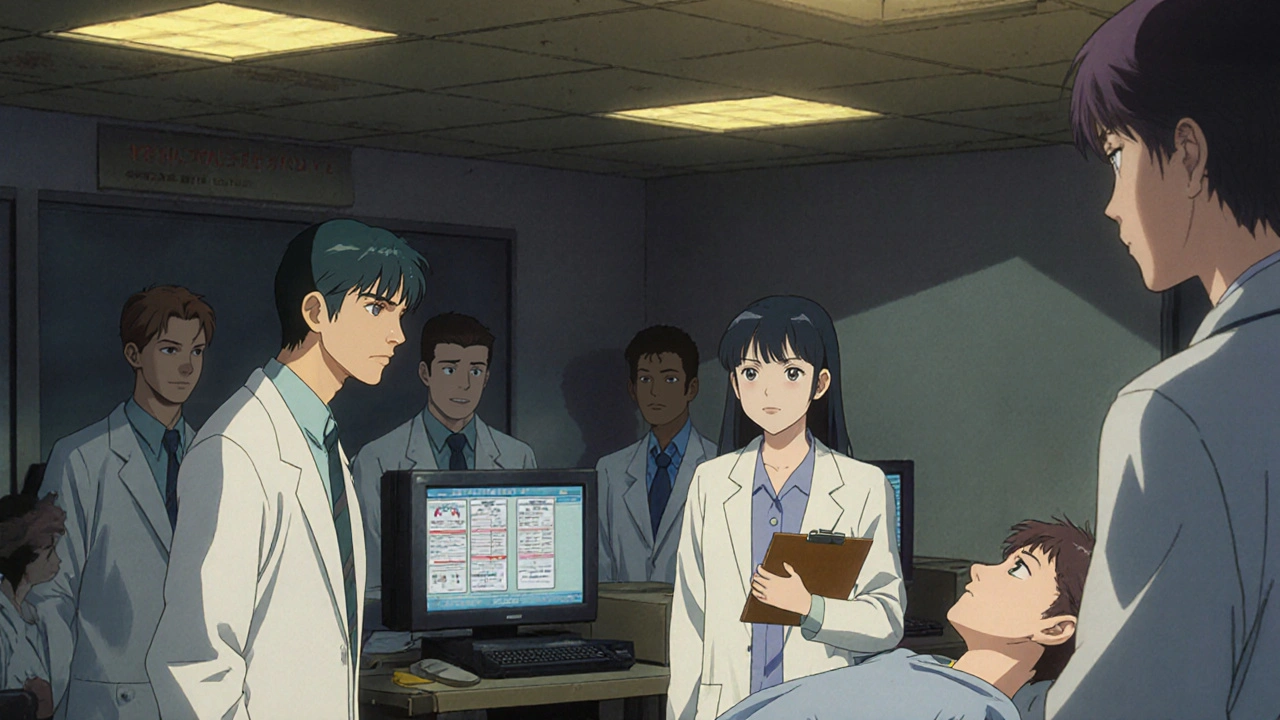
When patients leave the doctor’s office confused, or when nurses and doctors miscommunicate during shift changes, the consequences aren’t just frustrating-they’re dangerous. Research shows that healthcare communication failures contribute to up to 80% of serious medical errors, according to The Joint Commission. That’s not a small number. It’s a systemic problem. And the solution isn’t more staff or better technology-it’s better training.
Why Communication Training Isn’t Optional Anymore
For years, hospitals focused on curing diseases. But now, they’re realizing that how care is delivered matters just as much as what’s being treated. Poor communication leads to missed diagnoses, medication errors, and patients who don’t follow treatment plans. The Agency for Healthcare Research and Quality found that 15-20% of adverse patient outcomes stem directly from communication breakdowns. That’s not just bad luck-it’s preventable. Institutional generic education programs are now being built to fix this. These aren’t one-off workshops. They’re structured, evidence-based curricula designed to teach real skills: how to listen without interrupting, how to explain complex diagnoses in plain language, how to handle angry families, and how to coordinate care across teams. These programs are no longer optional perks-they’re tied to hospital funding. Medicare now links 30% of reimbursements to patient satisfaction scores, and communication is the biggest factor in those scores.What These Programs Actually Teach
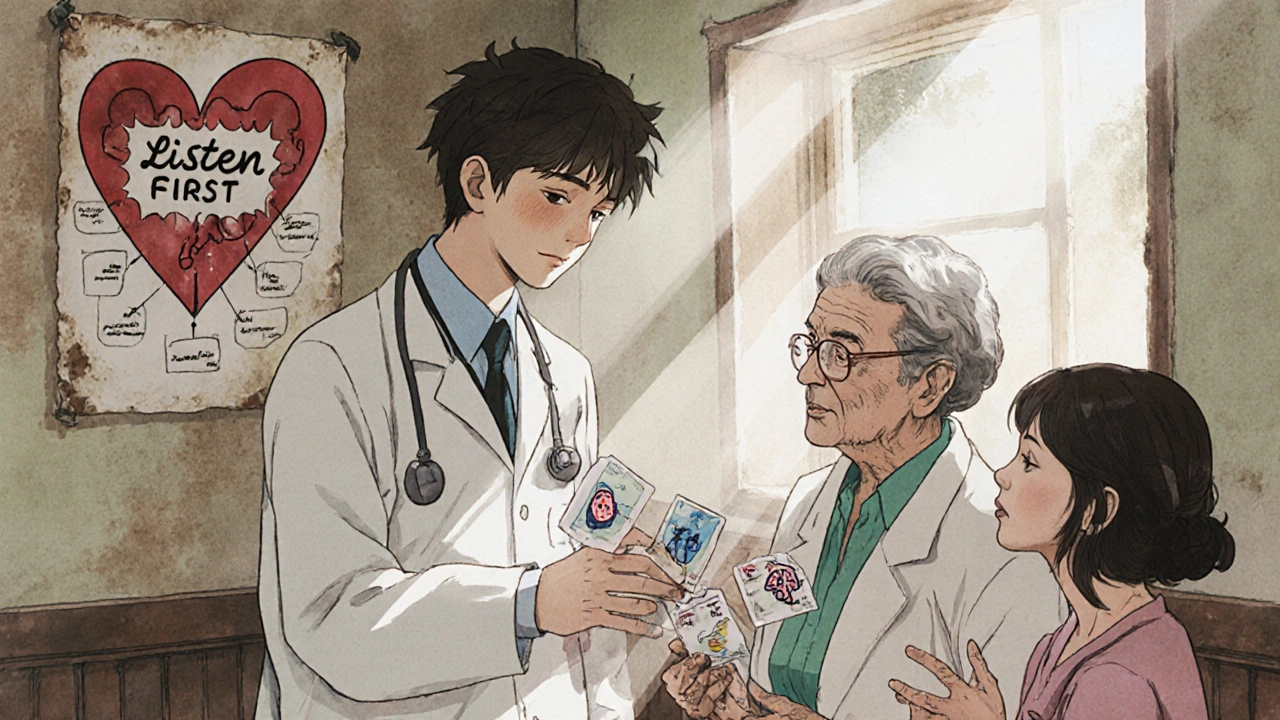
Not all communication training is the same. Some focus on doctors talking to patients. Others train nurses and pharmacists to speak the same language. Here’s what you’ll find in top programs today:- Eliciting the patient’s story: Instead of jumping to questions, clinicians are taught to start with, “Tell me what’s been going on.” This simple shift increases patient trust and uncovers hidden symptoms.
- Responding with empathy: Saying “I understand this is scary” isn’t just nice-it’s clinical. Studies show patients who feel heard are more likely to take their meds and show up for follow-ups.
- Setting boundaries: Nurses and doctors often burn out from emotional overload. Training now includes techniques to manage difficult conversations without absorbing the stress.
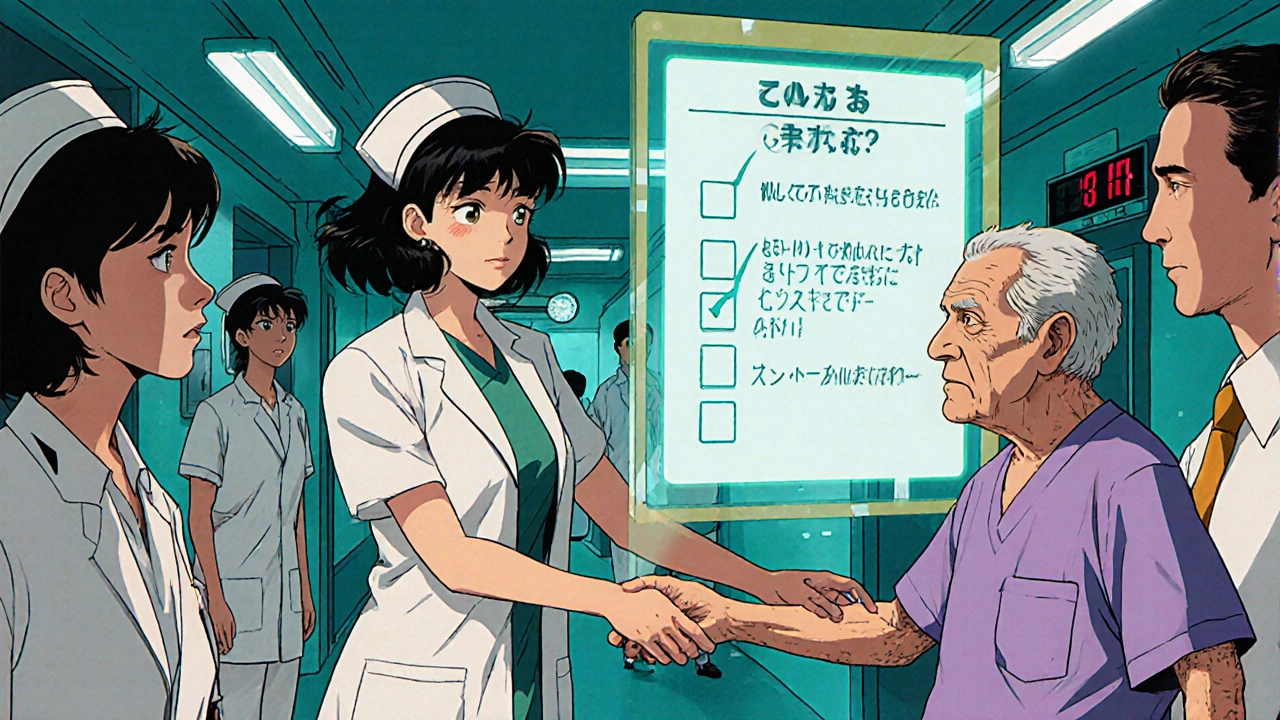
- Interprofessional communication: 65% of communication failures happen between teams-not between doctor and patient. Programs now teach handoff protocols, shared terminology, and structured checklists for shift changes.
- Cultural humility: 60% of programs still ignore this, but the best ones now teach how language, race, and religion affect how patients understand health. A 2023 AHRQ report found a 28% gap in communication satisfaction between white patients and minority patients-training is the only way to close it.
Real Programs, Real Results
There are dozens of programs out there, but only a few have proven results. Here are three that stand out:Program for Excellence in Patient-Centered Communication (PEP) at the University of Maryland uses real patient feedback to shape its curriculum. After completing the 6.5-hour workshop, doctors saw a 23% increase in patient satisfaction scores. But here’s the catch: it takes 3-4 patient visits before these skills start feeling natural. It’s not magic-it’s practice.
Mayo Clinic’s Online CNE Course uses 12 standardized patient videos to teach tough scenarios: telling someone they have cancer, dealing with a patient who refuses treatment, or managing a family that’s arguing over care. Nurses who took the course reported a 40% drop in burnout after three months. Why? Because they finally had tools to handle emotional overload instead of just pushing through.
Northwestern University’s Mastery Learning Program is the most rigorous. Medical students must hit an 85% proficiency score on communication assessments before moving forward. They do 4-6 simulated patient encounters during rotations. The result? 37% better skill retention after six months compared to lecture-based training. But it’s expensive. It needs simulation labs, trained actors, and faculty who know how to give feedback. Not every hospital can afford it.
What’s Missing in Most Programs
Even the best programs have blind spots. Most don’t track whether skills stick beyond six months. A 2021 JAMA review found only 12% of programs follow up with clinicians after training. That’s like teaching someone to drive and never letting them get behind the wheel again. Another problem? Time. A 2023 AAMC survey found that 58% of healthcare workers say they know the right communication techniques-but they don’t have time to use them. Doctors average just 13.3 seconds before interrupting patients, even after training. That’s not a skills gap. That’s a system gap. And then there’s equity. Many programs still treat communication like a universal skill. But if you’re a Spanish-speaking grandmother who’s never heard the word “diabetes,” or a Black man who’s been dismissed by doctors before, generic training won’t help. The best programs now include modules on cultural humility, health literacy, and implicit bias-but only 74% of new programs do this, according to the AAMC.How Hospitals Are Making It Work
Successful hospitals don’t just send staff to a one-day seminar. They follow a four-step model developed by the Academy of Communication in Healthcare:- Assess the gap: Look at patient surveys. Where are complaints clustered? Is it discharge instructions? Pain management? That’s where you start.
- Pick 3-5 skills to focus on: Don’t try to fix everything. Master a few high-impact behaviors first.
- Train in context: Use real cases from your own clinic. Role-play scenarios your staff actually face.
- Embed it in the workflow: Add prompts to your electronic health record. For example: “Did you confirm patient understands next steps?”
Northwestern University found that when each clinical unit names a “communication champion”-a respected nurse or doctor who models the behavior-adoption jumps to 73%. Peer influence beats PowerPoint every time.


Karla Luis
November 27, 2025 AT 03:31So we're spending billions on training doctors to say 'I understand this is scary' but still can't get them to stop interrupting patients in 13 seconds? Classic. We're treating symptoms not the disease. The system's broken and no amount of empathy workshops fixes that.
jon sanctus
November 27, 2025 AT 07:31Oh wow. Another feel-good corporate training fantasy. You think telling a doctor to 'listen more' is going to fix the fact that they're paid by volume, not quality? This is performative wokeness dressed up as healthcare reform. The real problem? Profit motives. Not poor communication skills. Wake up.
Kenneth Narvaez
November 28, 2025 AT 01:21While the literature supports structured communication interventions, the effect sizes are modest at best. The meta-analyses by Beach et al. (2020) and Levinson et al. (2021) indicate that patient satisfaction improvements are statistically significant but clinically negligible when controlled for confounders like socioeconomic status and comorbidity burden. Moreover, the generalizability of simulation-based training is limited by ecological validity concerns.
Christian Mutti
November 29, 2025 AT 03:28THIS. IS. A. REVOLUTION. 🙌
For decades, we've treated medicine like a mechanical science-fix the lab values, prescribe the pill, move on.
But now? We’re finally acknowledging that healing isn’t just about biology-it’s about humanity.
When a nurse says 'I see how scared you are'-that’s not fluff. That’s medicine.
That’s the difference between survival and thriving.
And if your hospital still thinks PowerPoint slides count as training? They’re not just behind-they’re dangerous.
👏👏👏
Liliana Lawrence
November 30, 2025 AT 01:50And don't forget the cultural stuff!! 😊
Like, if your patient is a 70-year-old Mexican grandma who thinks diabetes means 'God's punishment' and you just hand her a pamphlet in English? That's not care, that's negligence. 🙏
Real training means learning how to talk to people, not just at them. Language isn't just words-it's trust. And trust? It's the only thing that saves lives when the meds run out.
Also, can we PLEASE stop calling it 'soft skills'? It's HARD skills. Like, brain surgery level hard. 💪
Sharmita Datta
December 1, 2025 AT 00:54mona gabriel
December 1, 2025 AT 11:54It’s funny how we treat communication like a checklist instead of a practice.
Like, sure, say 'I understand this is scary'-but what if you don’t mean it?
Patients feel that. They feel everything.
And no amount of role-playing fixes a system that treats humans like tickets to be processed.
Maybe we need fewer training modules and more time with each patient.
Or maybe just pay people enough to not hate their jobs.
Just saying.
Phillip Gerringer
December 2, 2025 AT 06:36Let’s be real-most clinicians don’t need training. They need to be replaced. You can’t fix incompetence with a 6.5-hour workshop. If a doctor still interrupts in 13 seconds after training, they’re either lazy or fundamentally unsuited for the job. The problem isn’t curriculum. It’s hiring. And the fact that we tolerate mediocrity in life-or-death roles is the real scandal.
jeff melvin
December 4, 2025 AT 02:41Training is a bandaid on a hemorrhage. The real issue is systemic understaffing. No amount of empathy coaching helps when you’ve got 12 patients, 3 emergencies, and 20 minutes per visit. Communication fails because time is stolen, not because skills are lacking. Fix the workload. Then talk about training.
Matt Webster
December 5, 2025 AT 23:53I’ve seen this work. Not in theory-in the trenches.
My unit started with one communication champion-a quiet RN who just asked people how they were *really* doing.
Within months, readmissions dropped. Families stopped yelling. Even the grumpy attendants started using the checklists.
It wasn’t magic. It was consistency. And respect.
People don’t need more lectures. They need to see someone they trust doing it right.
Start there.
Stephen Wark
December 7, 2025 AT 10:50Another article pretending training fixes everything. Let’s be honest-no one wants to sit through this stuff. It’s mandatory HR garbage. They make you watch videos during lunch, then slap a sticker on your badge and call it a day. Meanwhile, the ER is still a meat grinder. This is theater. Not transformation.
Daniel McKnight
December 8, 2025 AT 09:01They call it 'communication training' but it’s really emotional labor training.
And guess who’s doing the labor? Nurses. Women. People of color.
We’re teaching them to absorb trauma, manage rage, soothe grief-then acting surprised when they burn out.
Training should include: 'How to say no.' 'How to ask for help.' 'How to not carry the weight of the system on your back.'
Otherwise, it’s just exploitation with a PowerPoint.
Jaylen Baker
December 9, 2025 AT 10:22Yes. YES. This is the stuff that matters.
Not the flashy tech. Not the new machines.
It’s the quiet moment when someone says, 'I’m here with you.'
That’s the medicine that lasts.
And if your hospital doesn’t value that? Find one that does.
Because your life? It’s worth more than a checklist.
Fiona Hoxhaj
December 10, 2025 AT 22:58One must interrogate the epistemological underpinnings of this so-called 'communication training.' Is it not merely a neoliberal co-optation of humanistic values, repackaged as a compliance metric to satisfy accreditation bodies? The very notion that empathy can be quantified, assessed, and reimbursed betrays a profound ontological confusion: medicine as a technical enterprise, rather than a moral one. The Joint Commission’s involvement signals not progress, but the commodification of care itself.
Merlin Maria
December 11, 2025 AT 13:20Let’s not romanticize this. Most 'communication training' is performative. Clinicians are taught scripted phrases to pass surveys, not to connect. The 23% satisfaction increase? That’s patients being polite, not healed. The real metric is mortality reduction-and that hasn’t budged. Training is a distraction from the real work: systemic reform, funding, and staffing. Everything else is decoration.
Nagamani Thaviti
December 13, 2025 AT 00:22Kamal Virk
December 14, 2025 AT 17:41While the intent behind such initiatives is commendable, the implementation remains superficial. The absence of longitudinal data and the lack of integration with clinical decision-support systems render these programs largely symbolic. Without structural integration into workflow and performance evaluation, they remain educational artifacts rather than operational necessities.
Elizabeth Grant
December 16, 2025 AT 09:17My grandma died because no one explained her meds in a way she understood.
Not because she was dumb.
Because no one bothered to sit down.
So I started volunteering at the clinic. Just asking: 'What does this mean to you?'
It changed everything.
Training’s great.
But real change? Starts with one person deciding to listen.
Not because they have to.
Because they care.