
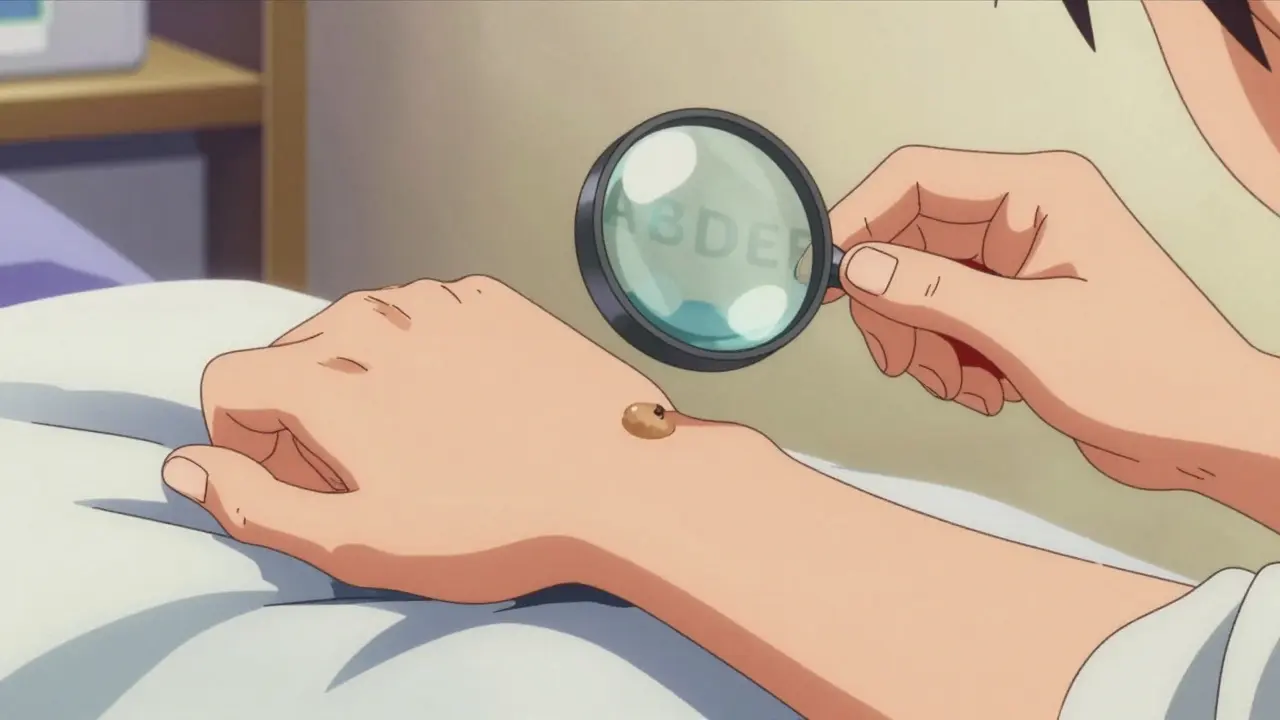
Spotting a strange mole is an unsettling experience. You might wonder if it's just a harmless freckle or something that needs a doctor's immediate attention. The truth is that early detection isn't just helpful-it's life-saving. When Melanoma is a dangerous form of skin cancer that develops in the melanocytes, the cells that produce pigment is caught at stage 0 (in situ), the five-year survival rate is a staggering 99%. However, if it reaches stage IV, that number drops to about 32.6%. This is why knowing how to screen your skin is one of the most important health habits you can develop.
The ABCDE Rule: Your First Line of Defense
Since the 1980s, dermatologists have used the ABCDE rule to simplify the complex signs of malignant melanoma. Think of it as a checklist for your skin. While it's not a definitive diagnosis, it helps you decide when a mole is "suspicious" enough to justify a professional visit.
- A is for Asymmetry: Imagine drawing a line through the middle of the mole. If the two halves don't match, it's asymmetrical.
- B is for Border: Healthy moles are usually round or oval with clean edges. Warning signs include borders that are jagged, blurred, notched, or "scalloped."
- C is for Color: A normal mole is usually one shade of brown. Be on the lookout for a mixture of colors-tan, black, red, white, or even blue-within a single lesion.
- D is for Diameter: Traditionally, anything larger than 6mm (about the size of a pencil eraser) is a red flag. However, some clinics now use 5mm as the threshold, and about 30% of melanomas are actually smaller than 6mm when first found.
- E is for Evolving: This is the most critical sign. Is the mole growing? Is the color shifting? Has it started to itch or bleed? Any change in a pre-existing mole is a reason for concern.
Some experts have expanded this to "ABCDEFG," adding F for "Funny looking" (anything that just doesn't look right) and G for "Growing rapidly."
Why the ABCDE Rule Isn't Perfect
Despite its popularity, the ABCDE rule has some blind spots. It's a great screening tool, but it can lead to a false sense of security. For instance, some types of skin cancer, like desmoplastic melanoma, only show classic ABCDE features in about 15% of cases. Similarly, childhood melanomas often don't follow these patterns.
A common danger is the "waiting game." Some people delay seeing a doctor because their mole doesn't hit three or four of the ABCDE marks. In one patient survey, 42% of people delayed care for an average of seven months because they thought their lesion wasn't "suspicious enough." Remember: the rule is a guide, not a law. If something looks off, get it checked regardless of how many letters it ticks off.
| Method | Pros | Cons | Approx. Accuracy |
|---|---|---|---|
| Visual ABCDE Check | Fast, free, accessible | High false positives; misses early lesions | 75% (Visual only) |
| Ugly Duckling Sign | Catches moles that ABCDE misses | Requires a baseline of other moles | 73% (Additive) |
| Digital Dermoscopy | High precision; sees deeper layers | Requires specialist equipment | 92% |
| AI-Assisted Tools | Analyzes millions of images | Not yet universal in all clinics | 95% (Specific trials) |
The "Ugly Duckling" Concept
If you're struggling with the ABCDEs, try the Ugly Duckling Sign. This is the idea that most moles on a person's body look similar to one another. If you have a group of similar-looking brown spots, but one stands out as being darker, larger, or just "different" from the rest, that's the ugly duckling. Research shows this method can catch about 73% of melanomas that the ABCDE rule misses.
When Does a Doctor Decide to Biopsy?
Not every suspicious mole needs to be cut out, but a Biopsy is the only way to know for sure if a lesion is cancerous. Doctors typically don't just use the ABCDEs; they combine them with clinical experience and technology.
Generally, a biopsy is recommended if:
- The lesion meets three or more ABCDE criteria.
- There is clear evidence of change over a 3-to-6 month window.
- The mole is a clear "ugly duckling" compared to others on your skin.
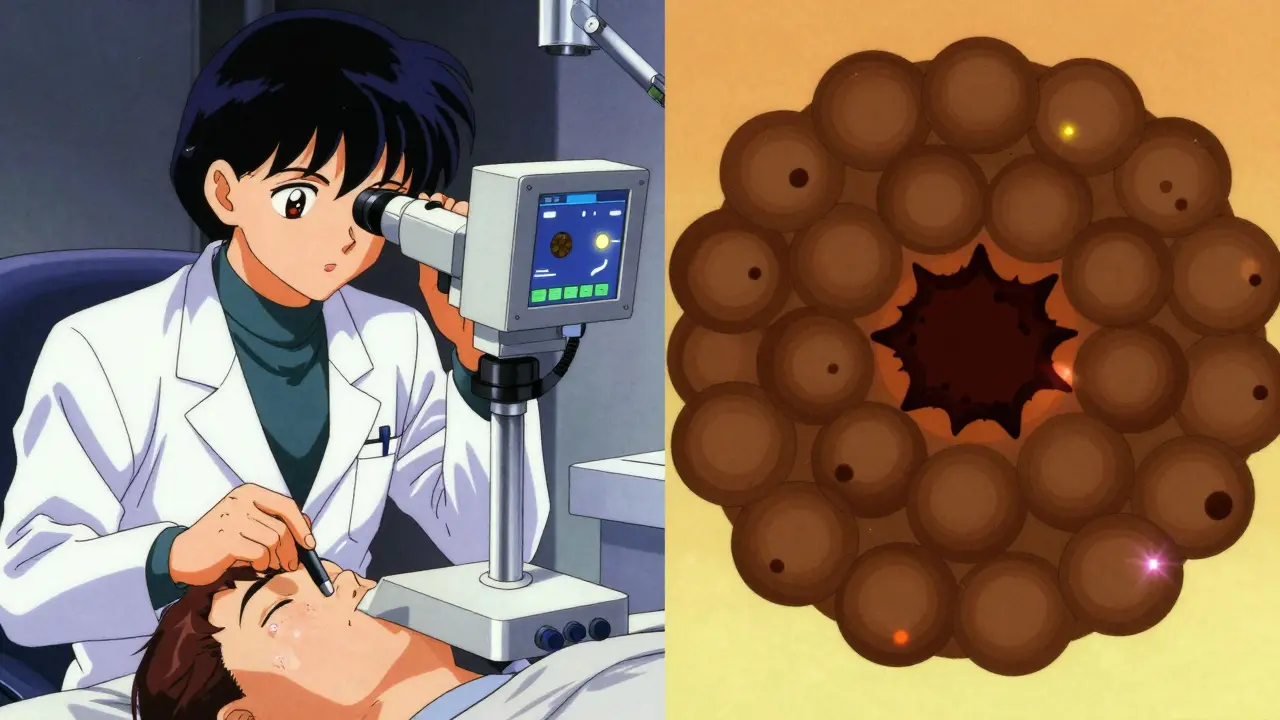
To avoid unnecessary surgeries, many dermatologists now use Digital Dermoscopy, which is a handheld microscope that allows them to see the pigment structures beneath the skin's surface. This tool helps reduce "false positive" biopsies-where a benign mole is removed-saving patients from unnecessary scarring and the healthcare system millions of dollars.
The Future of Skin Checks: AI and Molecular Tests
We are moving toward a world where you might not need as many surgical biopsies. New AI-assisted devices, like SkinVision, analyze photos using the ABCDE framework and other hidden parameters to flag high-risk lesions with incredible sensitivity.
Furthermore, some academic centers are using molecular tests, such as the 23-gene expression profile test. Instead of just looking at the shape of the mole, these tests look at the genetic makeup of the cells to determine if the cancer is likely to spread. This high-tech approach can reduce unnecessary surgical interventions by up to 31%.
Practical Tips for Your Monthly Skin Check
You don't need to be a doctor to perform a basic screen. The best way to track melanoma detection is to create a baseline. Since most of us can't remember exactly how a mole looked six months ago, documentation is key.
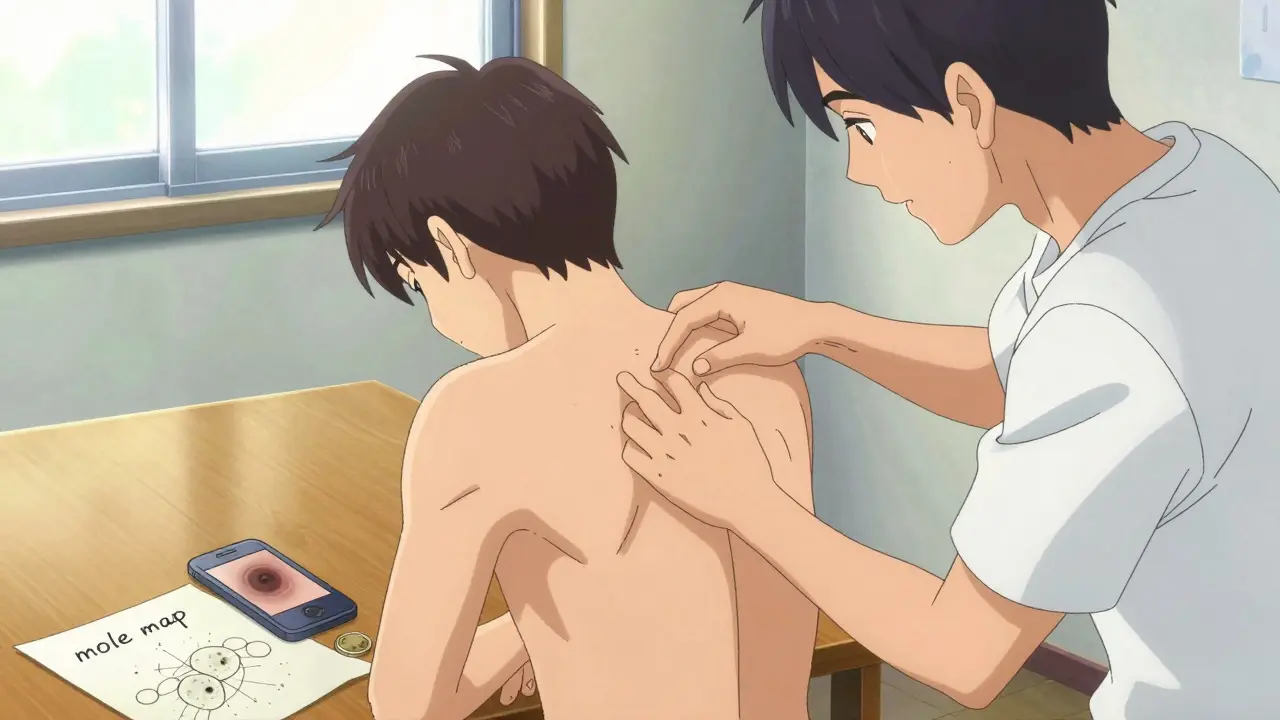
- Use a Mole Map: Use a full-body map to mark where your moles are. This prevents you from missing a spot or ignoring a new one.
- Take Photos: Use your smartphone to take clear, well-lit photos of any suspicious spots. Include a coin or a ruler in the photo to track the size accurately.
- Check Everywhere: Melanoma can hide in places you don't usually look. Check your scalp, between your toes, and the soles of your feet.
- Partner Up: Some spots on your back are impossible to see. Ask a partner or friend to help you scan areas you can't reach.
Can a mole be cancerous if it doesn't follow the ABCDE rules?
Yes. Between 20% and 30% of melanomas lack the classic ABCDE features. Some may be perfectly symmetrical or very small. This is why any mole that feels "different" or changes over time should be checked by a professional, regardless of whether it fits the criteria.
How often should I check my skin?
Dermatologists generally recommend a self-examination once a month. This frequency allows you to notice "evolution" (the E in ABCDE) more accurately, as subtle changes in size or color become more obvious when you're familiar with your skin's baseline.
Is a biopsy always necessary for a suspicious mole?
Not always. A doctor may use digital dermoscopy to determine if a lesion is benign. However, if the dermoscopy is inconclusive or if the mole shows strong signs of malignancy, a biopsy is the gold standard for diagnosis and must be performed.
Does a small diameter mean a mole is safe?
No. While the "D" in ABCDE traditionally refers to moles larger than 6mm, roughly 30% of melanomas are detected when they are smaller than that. Size is just one factor; color and change are often more important indicators.
What is the "Ugly Duckling" sign exactly?
The Ugly Duckling sign is a method of comparing a suspicious mole to all other moles on your body. If one mole looks significantly different from your "standard" mole pattern-whether in color, shape, or size-it is treated as an ugly duckling and should be biopsied.





Dale Kensok
April 28, 2026 AT 06:35The reductionist nature of the ABCDE heuristic is fundamentally insufficient for a comprehensive diagnostic paradigm. We are witnessing a cognitive dissonance where the layperson relies on a simplistic taxonomic structure while ignoring the stochastic variability of desmoplastic morphologies. One must contemplate the ontological gap between a visual approximation and the molecular veracity provided by 23-gene expression profiling. To suggest that a 'funny looking' mole is a valid clinical indicator is to succumb to an anecdotal epistemology that borders on the farcical. We should be discussing the systemic integration of AI-driven algorithmic synthesis rather than clinging to these antiquated, linear checklists that fail to account for the multifactorial etiology of cutaneous malignancies. It is quite frankly an embarrassment that we still treat the 'Ugly Duckling' sign as a primary heuristic in an era of digital dermoscopy and genomic sequencing.
Sharon Mathew
April 28, 2026 AT 12:55Oh please! As if a little app or a 'map' is going to save anyone! The sheer melodrama of acting like a ruler and a coin are revolutionary tools for skin cancer is just laughable!
Kevin Taggart
April 30, 2026 AT 01:35i didnt know bout the ugly duckling thing... kinda makes sense tho :) 🧐
Trish Perry
May 1, 2026 AT 22:23It's interesting how we spend so much time obsessing over the physical markers of our bodies, almost like we're trying to read our own destiny in the patterns of our skin. There's something about the 'evolution' part of the guide that really hits home-it's a reminder that we are constantly changing, even in ways we can't see without a mirror or a doctor.
Abhishek Charan
May 3, 2026 AT 14:26Actually, relying on AI-assisted tools is a terrible idea!!! Who knows what data these algorithms are trained on??? 🚩 I would trust a human eye over a machine every single time!!! 🙄
Darrin Oneto
May 3, 2026 AT 19:02my derm used that digital thingy on me last year and it was wild how much more you see. total game changer for not having to hack off every little bump on my arm lol
Jonathan Hall
May 5, 2026 AT 04:08While I generally try to see the best in all medical approaches and appreciate the effort to make this information accessible to the masses, I find it absolutely negligent and frankly disgusting that some clinics are still using outdated standards while patients suffer in the interim, although I do believe that if we just communicate better across borders we can standardize this care for everyone regardless of their socioeconomic status because no one should have to guess if a mole is deadly while waiting for an appointment that takes six months to get.
Kat G
May 5, 2026 AT 08:28Regular checks are important for everyone.
Thomas Jorquez
May 7, 2026 AT 05:51The information provided is quite useful. I appreciate the clear break down of the signs, even if the spelling in some of these forums is a bit lax.
Michael Yoste
May 8, 2026 AT 17:10You guys are overthinking it. Just go to the doctor if it looks weird. I've seen so many people panic over a freckle when they just needed a basic checkup, it's almost funny how much we stress!
Aubrey Johnson
May 9, 2026 AT 16:45The 'Ugly Duckling' method is simply common sense. If it doesn't fit the pattern, it's a problem. It is not a complex theory.
Steve Grayson
May 11, 2026 AT 13:51I agree with that. Keeping it simple usually works best for most people.