

Lithium Toxicity Risk Estimator
Patient Parameters
Enter your details and click calculate to see the estimated impact on your lithium levels.
Imagine taking a daily pill that keeps your mood stable for years. You trust it. It works. Then, you pick up a bottle of ibuprofen for a headache or start a new blood pressure medicine. Within days, that same trusted pill starts turning against you. This isn’t science fiction; it is the reality for thousands of people managing bipolar disorder with lithium carbonate. Lithium has a notoriously narrow therapeutic window. The difference between a helpful dose and a toxic one is razor-thin. When you introduce other common medications-specifically diuretics and non-steroidal anti-inflammatory drugs (NSAIDs)-you disrupt how your kidneys handle lithium. The result? Lithium levels can spike dangerously high, leading to toxicity that ranges from tremors to seizures, and in rare cases, death. Understanding these interactions is not just academic; it is a matter of life and death.
Why Lithium Is So Sensitive to Other Drugs
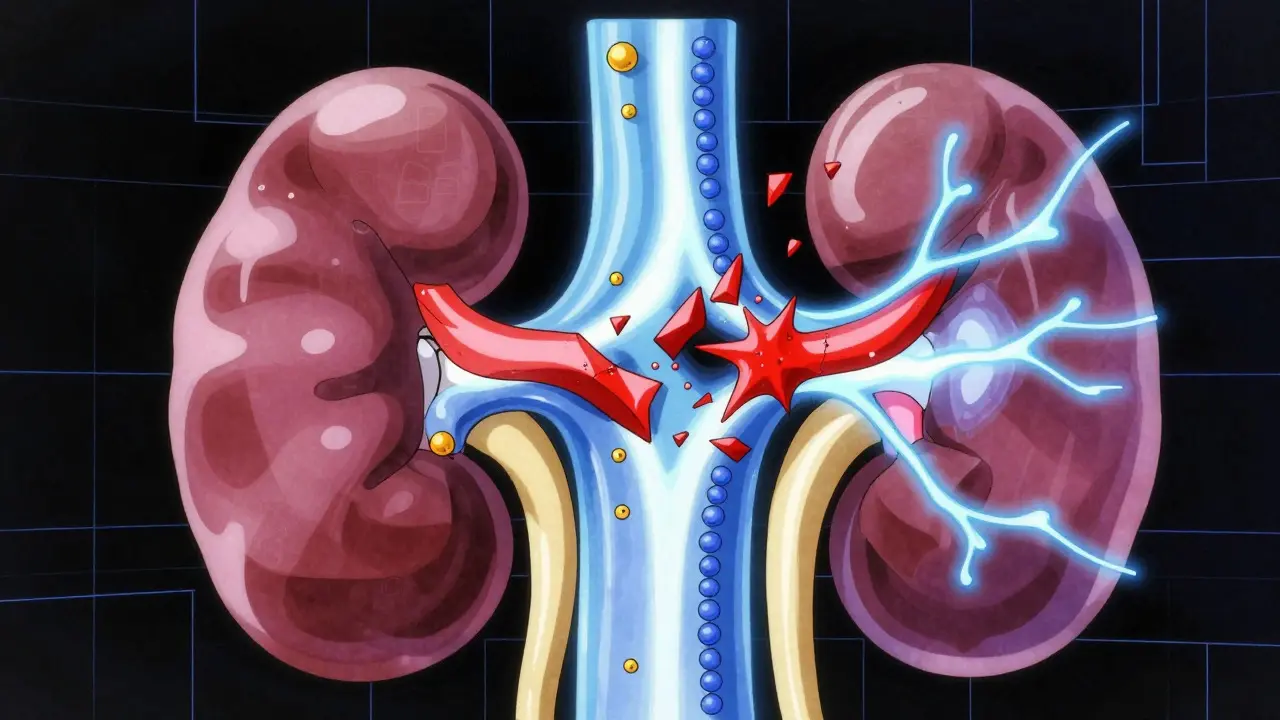
To understand why these interactions happen, you have to look at how your body processes lithium. Unlike most drugs, which are broken down by the liver, lithium is not metabolized at all. It stays exactly as it is until your kidneys filter it out. This makes your renal system the sole gatekeeper of lithium levels in your blood. Your kidneys work through a process called glomerular filtration. Once filtered, about 60% to 80% of that lithium is reabsorbed back into your bloodstream in the proximal tubule of the nephron. This reabsorption happens alongside sodium. Here is the critical link: when your body loses sodium or water, it tries to hold onto both. Since lithium mimics sodium, your kidneys often mistake lithium for sodium and reabsorb it instead of letting it go. Any drug that affects sodium balance, kidney blood flow, or prostaglandin production can trigger this mechanism, causing lithium to build up in your system.
| Category | Serum Level (mmol/L) | Clinical Status |
|---|---|---|
| Maintenance Therapy | 0.6 - 1.2 | Therapeutic / Safe |
| Mild Toxicity | ≥ 1.5 | Nausea, tremor, diarrhea |
| Moderate Toxicity | ≥ 2.0 | Confusion, slurred speech, ataxia |
| Severe Toxicity | ≥ 2.5 | Seizures, coma, requires dialysis |
The Diuretic Danger: Thiazides vs. Loop Diuretics
Diuretics, commonly known as water pills, are frequently prescribed for high blood pressure or heart failure. However, they pose a significant risk to patients on lithium. Not all diuretics are created equal, though. The type of diuretic matters immensely because different classes act on different parts of the kidney. Thiazide diuretics, such as hydrochlorothiazide and bendroflumethiazide, are the biggest culprits. They work on the distal convoluted tubule but cause a secondary effect upstream: they lower blood volume, which triggers the proximal tubule to aggressively reabsorb sodium-and lithium. Studies show thiazides can increase lithium levels by 25% to 40% within just three to five days. In some severe cases, levels have quadrupled. If you are on a thiazide, your doctor will likely need to reduce your lithium dose by 20% to 25% immediately upon starting the diuretic. Loop diuretics, like furosemide, are generally safer but not risk-free. They act on the loop of Henle and tend to flush out more sodium than they save, which can sometimes counteract the lithium-retaining effect. However, in patients with pre-existing kidney impairment (eGFR below 60 mL/min/1.73m²), loop diuretics can still raise lithium levels by 10% to 25%. Furosemide is often considered the preferred diuretic if one is absolutely necessary, but it still requires close monitoring.
NSAIDs: The Hidden Risk in Your Medicine Cabinet
If diuretics are the slow-burning threat, NSAIDs are the sneaky ones. Why? Because many of them are available over the counter. You might take ibuprofen for a sore back or naproxen for arthritis without telling your psychiatrist. This self-medication is a leading cause of accidental lithium toxicity. NSAIDs inhibit the production of prostaglandins in the kidney. Prostaglandins help keep blood vessels in the kidney dilated, ensuring good blood flow and filtration. When you block them, the kidney’s filtration rate drops by 10% to 20%. With less filtering happening, less lithium leaves your body. The severity depends heavily on the specific NSAID:
- Indomethacin: The highest risk. Can increase lithium levels by 30% to 40%.
- Piroxicam & Naproxen: Moderate to high risk. Increases of 15% to 30%.
- Ibuprofen: Common risk. Raises levels by 15% to 20%.
- Celecoxib: The safest option among NSAIDs. It shows only a 5% to 10% increase because it is a COX-2 selective inhibitor, affecting kidney prostaglandins less than traditional NSAIDs.
Recognizing the Signs of Lithium Toxicity
You cannot always rely on how you feel to detect early toxicity, especially since mild symptoms mimic side effects you might already tolerate. However, knowing the progression is vital. Mild toxicity (levels ≥ 1.5 mmol/L) often presents as nausea, vomiting, diarrhea, and a fine hand tremor. Many patients ignore these, assuming they are just having an off day. As levels climb to moderate toxicity (≥ 2.0 mmol/L), neurological symptoms take over. You may experience slurred speech, unsteady gait (ataxia), confusion, and muscle twitching. Severe toxicity (≥ 2.5 mmol/L) is a medical emergency. Symptoms include coarse tremors, seizures, irregular heartbeat, and coma. Crucially, even if blood tests show normal levels after treatment, intracellular lithium stores may remain high. This means clinical decompensation can occur hours or days later, requiring prolonged observation or hemodialysis.

Management Protocols: Monitoring and Mitigation
If you are prescribed lithium, you must adopt a proactive stance on drug interactions. The American Psychiatric Association’s 2021 guidelines provide clear directives:
- Baseline Check: Before starting any new medication, ensure your current lithium level and kidney function (eGFR) are stable.
- Frequent Monitoring: If you start an NSAID or diuretic, check your lithium levels every 4 to 5 days for the first month. Do not wait for your routine 3-to-6-month appointment.
- Dose Adjustment: Be prepared to lower your lithium dose. A 15% to 20% reduction is typical for NSAIDs; 20% to 25% for thiazides.
- Hydration: Maintain consistent fluid and salt intake. Dehydration amplifies the effects of both diuretics and NSAIDs on lithium retention.
Future Directions and Patient Empowerment
The landscape of lithium management is evolving. Recent FDA approvals have led to smartphone-connected home testing devices, allowing patients to monitor their levels more frequently without hospital visits. Additionally, research into genetic factors, such as CYP2D6 metabolism, suggests that personalized dosing algorithms could soon predict who is most susceptible to these interactions. Until then, the burden falls on communication. Tell every doctor, dentist, and pharmacist that you take lithium. Read labels on over-the-counter painkillers. And never assume a "common" drug is harmless. In the world of lithium, small changes can have massive consequences.
Can I take ibuprofen if I am on lithium?
You should avoid ibuprofen if possible. It can increase lithium levels by 15-20%, potentially pushing you into toxicity. If you must use it, limit the dose and duration, and check your lithium levels within 4-5 days. Acetaminophen is a safer alternative for pain relief.
Which diuretic is safest with lithium?
Loop diuretics like furosemide are generally safer than thiazide diuretics (like hydrochlorothiazide). Thiazides can raise lithium levels by up to 40%, whereas loop diuretics typically cause a smaller increase (10-25%), especially in patients with healthy kidney function.
How quickly do drug interactions affect lithium levels?
Interactions can happen rapidly. Significant increases in lithium levels can be seen within 3 to 5 days of starting a new interacting medication like a diuretic or NSAID. This is why frequent monitoring during the first week is critical.
What are the first signs of lithium toxicity?
Early signs include nausea, vomiting, diarrhea, and a fine hand tremor. As toxicity worsens, you may experience confusion, slurred speech, unsteady walking, and muscle twitching. Severe cases involve seizures and coma.
Is celecoxib safe to take with lithium?
Celecoxib is considered the safest NSAID option for patients on lithium. It interacts much less strongly with kidney function than traditional NSAIDs like ibuprofen or indomethacin, raising lithium levels by only 5-10% on average.





Tad Cronn
July 29, 2026 AT 11:32Trey Newkerk
July 31, 2026 AT 00:58Charles PINSON
July 31, 2026 AT 16:33John Anderson
August 1, 2026 AT 23:21Patrick Plummer
August 2, 2026 AT 09:06Kieran Healy
August 4, 2026 AT 03:33Kevin Burke
August 6, 2026 AT 01:58neal vince
August 6, 2026 AT 15:19Sinead Doyle
August 7, 2026 AT 13:59Samuel Friday
August 7, 2026 AT 17:33Emily Schor
August 9, 2026 AT 04:03