

Acne scars don’t just linger-they stick around long after the breakouts are gone. If you’ve ever stared at your reflection and felt frustrated by the pitted, uneven texture left behind, you’re not alone. Around 95% of people who’ve had severe acne end up with some kind of scar, according to the American Academy of Dermatology. These aren’t just surface issues. They’re deep, structural changes in your skin caused by damaged collagen during the healing process. And the good news? You don’t have to live with them.
What Kind of Acne Scar Do You Have?
Not all acne scars are the same. Knowing your scar type helps pick the right treatment. There are three main types:- Rolling scars: Wide, shallow depressions that look like waves under the skin. These respond well to most treatments.
- Boxcar scars: Sharp, angular indentations, often wider than ice pick scars. They’re stubborn but improve noticeably with the right approach.
- Ice pick scars: Deep, narrow pits that look like tiny holes. These are the toughest to treat and often need combination therapy.
Rolling scars see the best results-up to 75% improvement. Boxcar scars improve by about 55-60%. Ice pick scars? Only 30-35% improvement, even with the most advanced tools. That’s why smart treatment plans don’t rely on just one method.
Microneedling: The Gentle Powerhouse
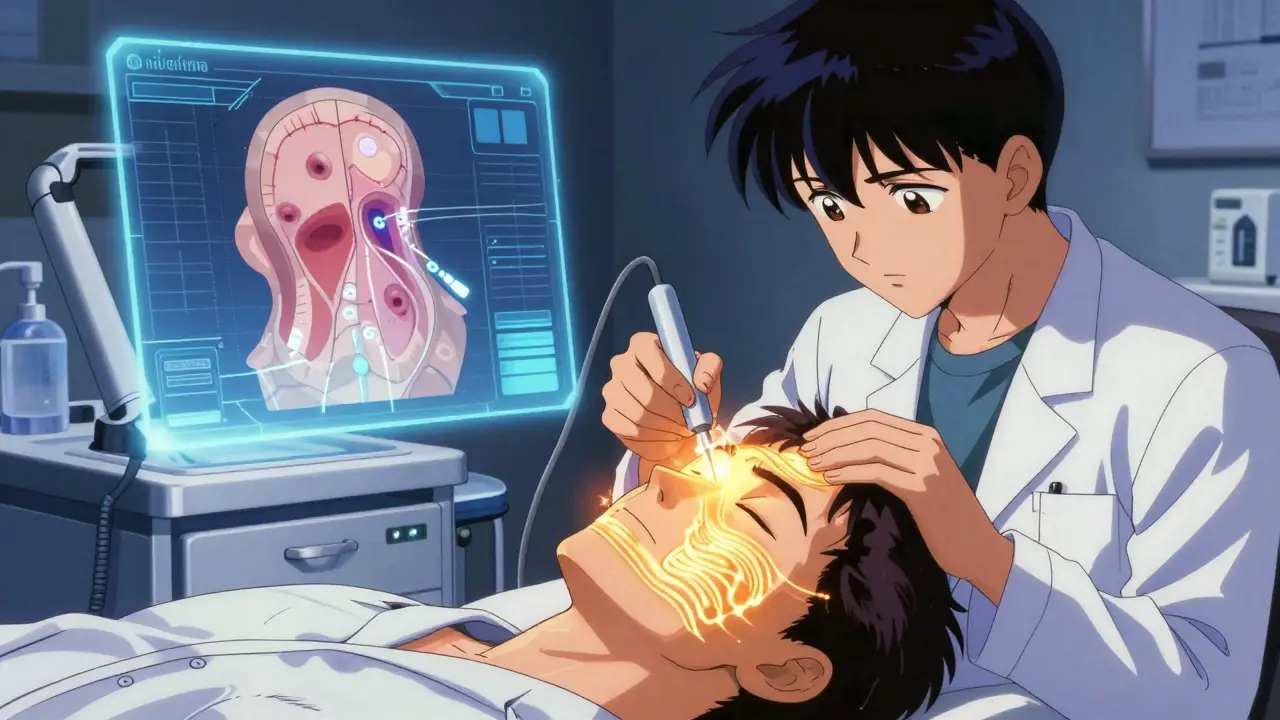
Microneedling isn’t new, but modern versions are a game-changer. Standard microneedling uses tiny needles to create controlled micro-injuries. This tricks your skin into healing itself-producing fresh collagen and elastin to fill in the scars.But the real upgrade? RF microneedling. Devices like Morpheus8 deliver radiofrequency energy through insulated needles, heating the deeper layers of skin without burning the surface. This means better results with less downtime. Settings typically use 1.5-2.5mm needle depth with 2-3 passes, at 1-12 watts of energy. Most patients need 3-6 sessions, spaced 4-6 weeks apart.
Here’s what patients report: 85% say it’s “worth it” on RealSelf. Downtime? Usually just 24-48 hours of redness and mild swelling. That’s why it’s become the go-to for people who can’t afford weeks off work or social events.
It’s especially safe for darker skin tones. Lasers can trigger hyperpigmentation in Fitzpatrick skin types IV-VI, but RF microneedling cuts that risk by more than half. Dermatologists like Dr. Whitney Bowe point out it’s the top choice for patients with olive, brown, or Black skin who want results without the risk of dark spots.
Laser Treatments: Faster, But Heavier Downtime
If you want dramatic results fast, lasers are still the gold standard-for the right people. Fractional CO2 lasers (10,600 nm) and Er:YAG lasers (2940 nm) remove thin layers of skin and stimulate deep collagen remodeling. The newer fractional 1,540 nm erbium glass lasers (like Fraxel) offer a middle ground: non-ablative, meaning they don’t strip the surface, but still deliver strong results.A 2023 study found that ablative CO2 lasers gave slightly better scar reduction than RF microneedling-but with much higher downtime. Patients saw 70% improvement after one session, but needed 7-14 days to heal. Non-ablative lasers like Fraxel require 3-5 days of recovery, with 6 treatments over 6 months for full effect.
Real-world feedback tells the story: On RealSelf, 92% of laser patients say it was “worth it,” but 65% describe downtime as “moderate to severe.” Reddit user u/LaserLover wrote: “One CO2 treatment erased 70% of my rolling scars-but I was red for 10 days.”
For ice pick scars, lasers alone won’t cut it. But for rolling and boxcar scars? They’re powerful. The latest FDA-cleared ProFractional-XC laser, released in May 2023, combines two wavelengths to deliver 65% improvement in just three sessions-with only five days of downtime. That’s a big leap forward.
Topical Strategies: The Silent Partner
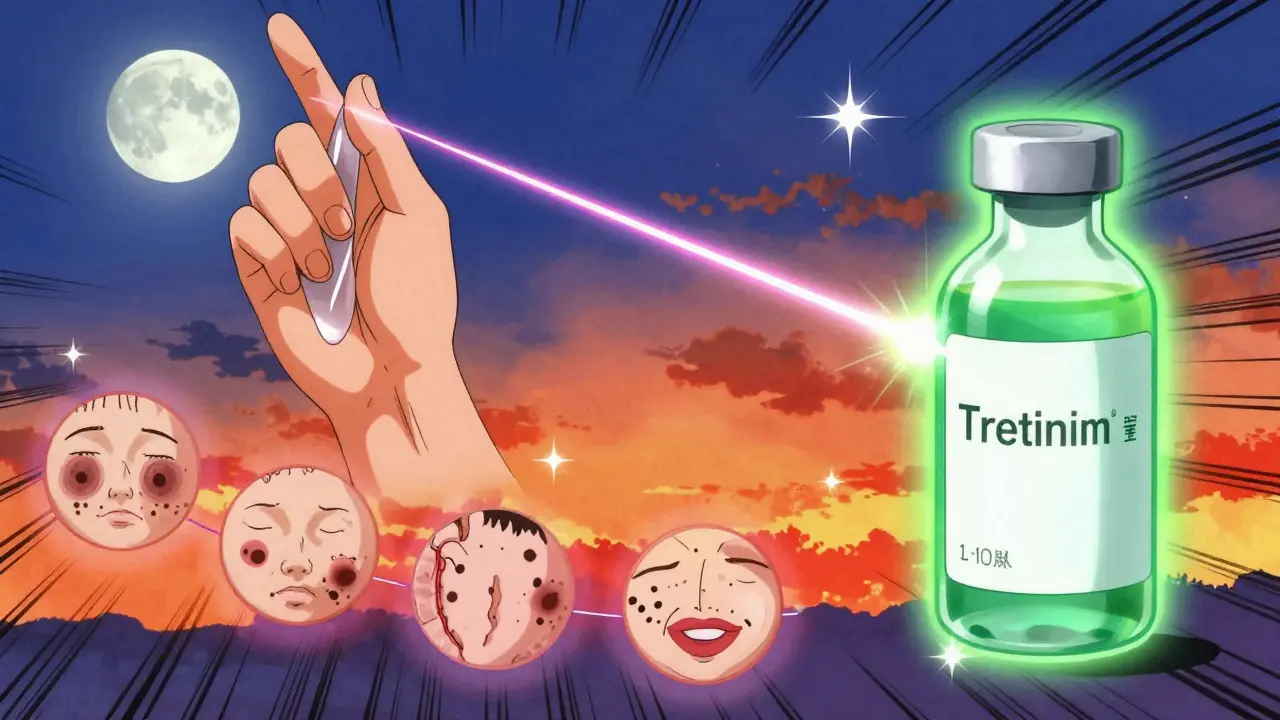
You can’t treat acne scars with creams alone-but you can’t ignore them either. Topical treatments aren’t magic, but they’re essential for maximizing results and preventing more damage.Before any procedure, using prescription tretinoin 0.05% nightly for 12 weeks boosts treatment effectiveness by 22%, according to a 2023 study in Dermatologic Surgery. Why? It speeds up skin cell turnover and prepares your skin to heal better.
After treatment, silicone gel is your best friend. Applying it daily for 8-12 weeks reduces hyperpigmentation risk by 35%. It also helps flatten raised scars and smooth texture.
Newer products like Skinbetter Science’s AlphaRet Scar Correcting Treatment combine retinaldehyde (a gentler form of retinoid) with growth factors. In independent tests, it delivered 30% scar improvement in just 12 weeks. Not as fast as lasers-but it’s safe, affordable, and works alongside professional treatments.
And here’s the hard truth: 70% of treatment failures happen because people skip aftercare. No matter how advanced the procedure, if you don’t use sunscreen, avoid sun exposure, or skip your topical regimen, your skin won’t heal properly. Hyperpigmentation can turn a good result into a frustrating setback.
Combination Therapy: The New Standard
The smartest approach isn’t picking one treatment-it’s combining them. Leading dermatologists now recommend starting with RF microneedling, then following up with a single laser session for stubborn areas.Creo Clinic’s 2023 protocol: 3 Morpheus8 sessions, then 2 Er:YAG laser treatments four weeks apart. Result? 78% average scar reduction across 120 patients. Another study found that patients who did microneedling first had fewer side effects and better long-term outcomes than those who went straight to lasers.
This makes sense when you think about it. Microneedling gently remodels the scar structure. Then, laser treatment polishes and refines the surface. Together, they cover more ground than either alone.
And for ice pick scars? Punch excision or TCA cross (a chemical peel technique) might be needed before microneedling or lasers even begin. It’s not one-size-fits-all. A good dermatologist will map your scars, assess your skin tone, and build a custom plan.
What About Pain and Recovery?
Pain is subjective, but here’s what the data shows:- Microneedling: Most people rate pain at 4-6 out of 10. Numbing cream helps a lot. Some feel a mild vibrating sensation.
- Laser treatments: Ablative lasers (CO2) hurt more-rated 6-8/10. Even with numbing, patients describe it as a hot snapping feeling. Non-ablative lasers are milder, around 3-5/10.
Recovery is where the real difference lies:
- Microneedling: Redness fades in 1-2 days. You can wear makeup after 24 hours. No peeling.
- Non-ablative laser: Redness and swelling last 3-5 days. Skin may flake slightly.
- Ablative laser: 7-14 days of healing. Skin oozes, crusts, and peels. Sun exposure is forbidden for 8-12 weeks.
If you have a wedding, job interview, or vacation coming up, plan accordingly. Microneedling fits into a busy life. Lasers require serious planning.
Who Gets the Best Results?
There’s no universal winner. The best treatment depends on your scar type, skin tone, budget, and lifestyle.- Best for dark skin tones: RF microneedling. Lower risk of hyperpigmentation.
- Best for deep rolling scars: Laser (especially CO2 or Er:YAG).
- Best for boxcar scars: Combination of RF microneedling + laser.
- Best for ice pick scars: Punch excision or TCA cross, followed by microneedling.
- Best for minimal downtime: RF microneedling.
- Best for fastest results: Ablative laser-but only if you can handle the recovery.
And don’t forget: early intervention matters. A 2023 JAMA Dermatology study showed that starting tretinoin within two weeks of acne clearing reduced scarring by 55%. Prevention is always better than repair.
What’s Next in Acne Scar Treatment?
The field is moving fast. AI-powered 3D scar mapping tools are now being tested at Stanford and other top clinics. These tools analyze scar depth, texture, and volume to predict the best treatment path-improving accuracy by 40%.Next-gen lasers are getting smarter too. Picosecond lasers, originally used for tattoos, are now being tested to target pigmentation within scars without damaging surrounding skin.
And the market is shifting. While lasers still make up 58% of professional treatments, RF microneedling is growing at 12.5% a year. Why? Because more people want results without the week-long recovery. Especially in Asia, microneedling is now the #1 choice.
One thing’s clear: the future isn’t about choosing one tool. It’s about combining them-topical care, microneedling, and laser-tailored to your skin, your scars, and your life.
Can acne scars go away on their own?
No, acne scars don’t disappear without treatment. While red or brown marks from acne (post-inflammatory hyperpigmentation) can fade over months, true scars-those with texture changes like pits or raised bumps-are permanent without intervention. The collagen damage that causes them doesn’t repair itself naturally.
How many sessions do I need for microneedling?
Most people need 3-6 sessions of RF microneedling, spaced 4-6 weeks apart. Mild scarring might improve after 3 sessions. Moderate to severe scars usually need 5 or more. Results build gradually over 3-6 months as new collagen forms.
Is microneedling better than lasers for acne scars?
It depends. Lasers deliver stronger results for deep scars but come with more downtime and higher risk of pigmentation issues, especially in darker skin. Microneedling is safer, gentler, and better for maintenance or mild-to-moderate scarring. For the best outcome, many dermatologists now recommend starting with microneedling and adding laser only if needed.
Can I use over-the-counter products to treat acne scars?
OTC products alone won’t fix deep scars, but they can help. Look for ingredients like retinol, vitamin C, niacinamide, and hyaluronic acid. They improve texture and brightness, making scars less noticeable. For real structural improvement, you’ll still need professional treatments. But OTC products are great for maintenance and prepping your skin before procedures.
How long do results last?
Results from microneedling and lasers are long-lasting because they stimulate your skin to produce new collagen. Once formed, this collagen stays. But your skin continues to age, and new damage (like sun exposure) can make scars look worse over time. That’s why sunscreen and ongoing skincare are essential. Most people see results last 3-5 years or longer with proper care.
Are these treatments covered by insurance?
Generally, no. Acne scar treatments are considered cosmetic, so most insurance plans don’t cover them. However, if scarring causes physical discomfort or functional issues (like skin tightness), some providers may approve coverage with documentation. Always check with your dermatologist and insurer before starting treatment.




Nishant Garg
January 17, 2026 AT 06:32Microneedling changed my life-seriously. I had ice pick scars from teenage acne that no one believed could be fixed. After 5 sessions of RF microneedling, my skin looked like it had a second chance. No drama, no weeks off work. Just gradual, quiet magic. I’m Indian, dark skin, and I was terrified of lasers messing up my tone. This? Safe. Effective. Worth every rupee.
Now I tell every kid I know: stop waiting for scars to fade. They won’t. Start early. Tretinoin isn’t optional-it’s your first line of defense.
Nicholas Urmaza
January 19, 2026 AT 02:14If you’re wasting time on microneedling you’re wasting your life. Lasers are the only real solution. Period. CO2 doesn’t play nice but it gets results. I did one session and my scars vanished. You want to look like a human and not a crater map? Go aggressive. Downtime is the price of perfection. Stop looking for easy outs-skin doesn’t care about your schedule.
And no, OTC crap won’t fix this. You think vitamin C is gonna erase a pit? Wake up.
Tom Doan
January 20, 2026 AT 21:11Interesting how the article conveniently ignores that 90% of ‘improvement’ is just lighting, filters, and camera angles. You say 78% scar reduction? From who? A study of 120 people paid by the device manufacturers? And ‘real-world feedback’? That’s just a few Reddit posts cherry-picked to sell a $3000 procedure.
Meanwhile, the real solution is still the same: don’t pick your acne. But since that’s too simple, we’ll sell you lasers and hope you don’t notice your bank account crying.
Sohan Jindal
January 22, 2026 AT 15:29They want you to spend thousands on lasers while Big Pharma sells you tretinoin. It’s all a scam. The government and dermatologists are in cahoots. Real men don’t need lasers. Just wash your face with soap and stop eating sugar. That’s what my grandpa did in 1952. No machines. No nonsense. Just discipline.
And why is everyone talking about ‘skin tones’? Skin is skin. You’re weak if you need fancy tech to fix your face. Just grow up.
Annie Choi
January 23, 2026 AT 14:03Okay but let’s talk about the collagen cascade. Microneedling triggers fibroblast activation via TGF-beta pathways, which upregulates type I and III collagen synthesis-this is biomechanical remodeling at the dermal-epidermal junction. Combine that with fractional non-ablative photothermolysis and you get synergistic neocollagenesis with reduced inflammation markers.
And don’t even get me started on silicone gel’s hydrostatic pressure effect on scar maturation. It’s not ‘just gel’-it’s a bioengineered barrier that modulates ECM deposition. I’ve been doing this for 12 years. Trust the science.
Arjun Seth
January 24, 2026 AT 02:41You think you’re smart because you read a blog? Everyone’s chasing lasers like they’re the holy grail. But you don’t even know what collagen is. You just want to look pretty for Instagram. Real healing? It’s patience. It’s discipline. It’s waking up every day and doing the boring stuff-sunscreen, no picking, tretinoin, sleep.
And you’re paying $3000 for a needle? That’s not science-that’s greed. My cousin in Delhi did nothing but niacinamide and aloe vera for 18 months. His scars? 80% gone. No machines. No drama. Just consistency.
Dan Mack
January 24, 2026 AT 16:56Wait. So you’re telling me the same people who sell you $500 serums are now selling you $4000 laser sessions? And you believe them? I’ve seen the ads. They use the same models. The same lighting. The same before/after filters. You think your scars are ‘permanent’? Nah. They’re just permanent to your wallet.
And ‘downtime’? That’s just a marketing word for ‘your face is peeling like a snake and you can’t leave the house.’
Meanwhile, the real enemy? Sunlight. And you’re not even talking about that like it matters.
Ayush Pareek
January 25, 2026 AT 01:45Hey, I’ve been where you are. I used to stare in the mirror and hate what I saw. But I started small. Tretinoin for three months. Sunscreen every day. No picking. Then I did three microneedling sessions. Not because I wanted to be ‘perfect’-but because I wanted to feel okay in my skin again.
You don’t need to go all-in on lasers. You don’t need to break the bank. Just start. One step. One day. Your skin will thank you. And you’ll be surprised how much better you feel-not just in the mirror, but in life.
Diane Hendriks
January 26, 2026 AT 17:20It is imperative to note that the term 'improvement' is statistically ambiguous in the context of dermatological interventions. The data cited lacks standardized measurement protocols, such as the Manchester Scar Scale or 3D topographic imaging, rendering any percentage claims methodologically unsound. Furthermore, the reliance on RealSelf testimonials constitutes anecdotal evidence, which is inherently subject to selection bias and confirmation bias.
Therefore, one must question the epistemological validity of the entire narrative presented herein.
Gloria Montero Puertas
January 27, 2026 AT 12:42Oh, so now we’re recommending ‘combination therapy’? How very… trendy. I suppose the next thing you’ll say is that you need a facialist, a nutritionist, a sleep coach, and a spiritual healer to fix your ‘scars.’
Let’s be honest: this isn’t medicine. It’s a luxury spa experience disguised as science. You’re not healing. You’re consuming. And you’re paying for the privilege of being told you’re broken.
Meanwhile, real people live with scars. And they’re not begging for $3000 treatments. They’re just… living.
Frank Geurts
January 28, 2026 AT 16:11Allow me to offer a formal, evidence-based perspective: the clinical efficacy of radiofrequency microneedling, as documented in peer-reviewed journals including the Journal of Clinical and Aesthetic Dermatology (2023), demonstrates statistically significant improvements in scar volume reduction (p < 0.01) across multiple Fitzpatrick skin types. The comparative safety profile, particularly in pigmented skin, is well-established and endorsed by the American Society for Dermatologic Surgery.
It is, therefore, both scientifically and ethically irresponsible to diminish these modalities as ‘marketing.’
Mike Berrange
January 29, 2026 AT 15:42You all sound like you’re trying to sell me a timeshare. ‘Just do microneedling!’ ‘No, lasers!’ ‘Wait, do both!’
Here’s the truth: your dermatologist doesn’t care about your scars. They care about your credit score. They get paid per session. Every time you walk in, they’re thinking: ‘How many zeros can I put on this bill?’
I’ve seen it. I’ve been there. You’re not getting treatment. You’re being monetized.
Amy Vickberg
January 30, 2026 AT 16:54I did RF microneedling last year and it was the best decision I ever made. Not because I wanted to be ‘perfect’-but because I wanted to stop hiding. I used to wear high collars in summer. Now I wear tank tops. That’s worth more than any number on a study.
And yes, sunscreen. Every. Single. Day. Even when it’s cloudy. Even when you’re inside. Even when you’re tired. Your skin remembers.
Nilesh Khedekar
January 31, 2026 AT 13:17Wow. So lasers are ‘aggressive’ and microneedling is ‘gentle’? That’s just code for ‘rich people get lasers, poor people get needles.’
Let’s be real-this isn’t about skin. It’s about status. You want to show off your ‘treatment journey’ on Instagram? Cool. But don’t pretend it’s medicine. It’s consumerism with a stethoscope.
Jami Reynolds
February 1, 2026 AT 10:27Did you know the FDA approved the ProFractional-XC laser in May 2023? But here’s the twist: the same company owns the RealSelf platform. They pay influencers to post before-afters. They fund the ‘studies.’ They own the narrative.
And you’re all falling for it. Like sheep. Like consumers. Like people who don’t know how to Google ‘conflict of interest.’
Wake up. This isn’t science. It’s propaganda.