
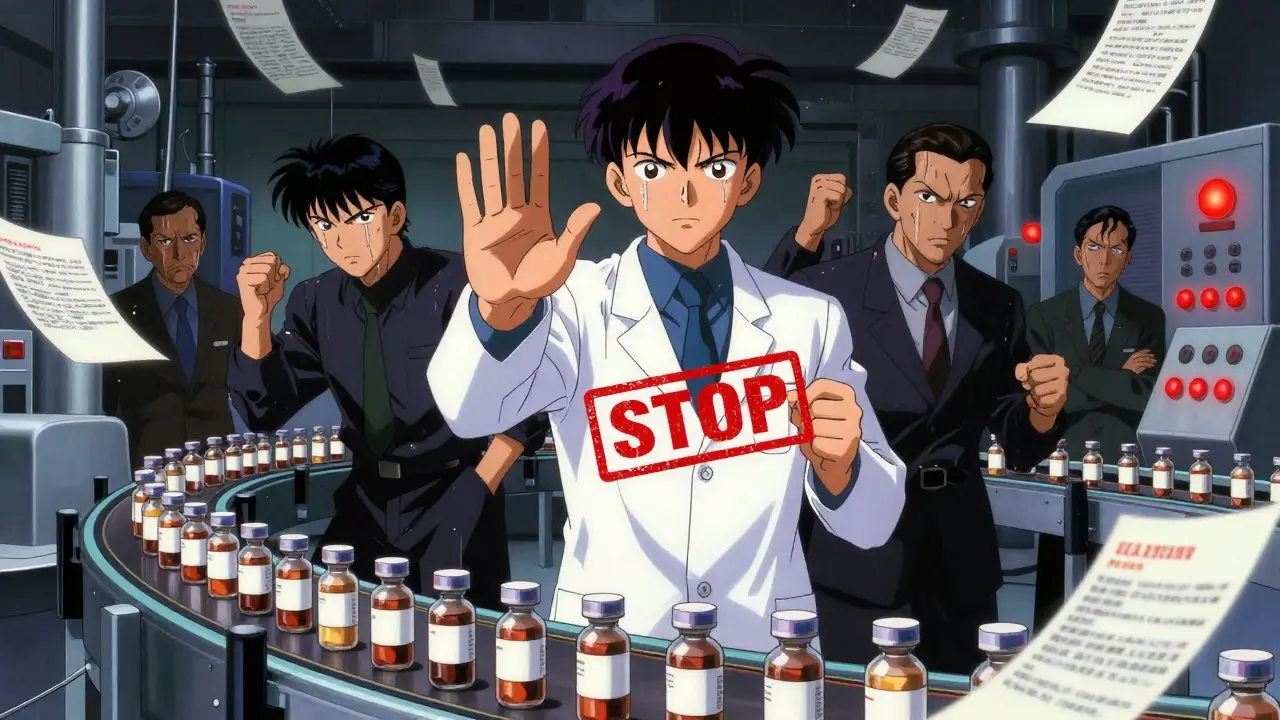
When a batch of medicine is released to patients, someone has to say yes - and that someone can't be the same person who made it. That’s the core idea behind quality assurance units (QUs). These aren’t just departments that check paperwork. They’re legally mandated watchdogs, designed to stop production mistakes before they reach people. And their independence isn’t a nice-to-have - it’s the only thing that keeps the system from collapsing under pressure.
Why Independence Isn’t Optional
The FDA made it clear in 2006: quality and production must be separate. Why? Because when the same team that’s racing to meet output targets also decides if a batch is safe, things go wrong. Production wants to move fast. Quality has to make sure it’s right. These goals don’t just clash - they actively undermine each other if there’s no wall between them.Look at the data. In 2024, 68% of FDA warning letters cited failures in QU independence. That’s up from 29% in 2020. Most of those letters came from facilities where the quality unit reported to the head of manufacturing. That’s not an accident. It’s a recipe for rubber-stamping. When a production manager says, “We’re behind schedule - just approve this batch,” and the quality team has no way to say no without fear, someone’s going to say yes. And someone’s going to get hurt.
The IAEA saw this same problem in nuclear plants after Three Mile Island. They didn’t just add more inspectors. They built a system where inspectors couldn’t be fired by the people they were watching. That’s the gold standard. If your quality team can’t raise a red flag without losing their job, they’re not independent. They’re just another cog in the machine.
What Does a Real Quality Assurance Unit Actually Do?
A quality assurance unit isn’t a team that reviews forms. It’s the final gatekeeper. Here’s what they’re legally required to control:- Approve or reject every incoming raw material
- Review and approve every production procedure before it’s used
- Check every batch record for accuracy and compliance
- Stop production if something’s off - no permission needed
- Reject entire batches if they don’t meet specs
This isn’t theoretical. In 2023, a small pharma company in Ohio shipped a batch of insulin that didn’t meet potency standards. Why? Because the quality manager was also the production supervisor. He approved the batch under pressure. The FDA found 14 other batches with the same issue. That’s not incompetence. That’s a broken structure.
The quality control unit (QC) does the testing. The quality assurance unit (QA) makes sure the system works. They’re different. QC checks the product. QA checks the process. If QA reports to production, the process gets ignored.
How Independence Works in Practice
A real quality assurance unit has three non-negotiable features:- Direct reporting line - to the CEO or Board of Directors, not the plant manager.
- Separate budget - if your QU’s funding comes from production, you’re not independent.
- Authority to halt - if they say “stop,” production stops. No exceptions.
Merck spent 8 months fixing this in 2023. Their QU used to report to the head of manufacturing. Employees were afraid to escalate issues. They restructured: QU now reports directly to the Chief Quality Officer, who reports to the CEO. Budgets were split. They added a formal “quality hold” procedure that bypasses production management entirely. Within a year, their FDA inspection score jumped from “warning” to “excellent.”
Small companies struggle with this. FDA data shows 42% of warning letters to facilities under 50 employees involve QU independence failures. Why? They can’t afford a full team. But there’s a fix: third-party oversight. More than 78% of nuclear facilities use shared independent oversight pools. The same model works for pharma. A small manufacturer can contract a qualified external QU to handle audits, batch reviews, and investigations. It’s cheaper than a recall.

What Happens When Independence Fails
In 2024, a Reddit user named “QualityAssurancePro” described how their company merged the production and QA roles during restructuring. Three months later, two critical deviations slipped through. One batch had incorrect labeling. Another had out-of-spec excipients. Both went to market. The FDA shut them down for six months. The cost? $18 million in lost sales, fines, and remediation.It’s not just about recalls. It’s about trust. A 2025 survey of 312 quality professionals found that 57% felt pressure to approve batches during production crunches. One in three said their QU didn’t have real authority to stop production - even though the FDA says they must.
And it’s not just pharma. In nuclear energy, the IAEA found that organizations with true independent oversight had 37% fewer critical compliance failures. That’s not a coincidence. It’s cause and effect.
What Skills and Structure Make a QU Effective?
A good quality assurance unit isn’t just about who reports to whom. It’s about who’s in it.- 8-12% of staff should be in the QU. Too few? You’ll miss things. Too many? You’re wasting money.
- 8.2 years of industry experience on average. This isn’t entry-level work.
- 100% must have GMP training. No exceptions.
- 78% need statistical process control skills to spot trends before they become problems.
- 65% need conflict resolution training - because they’ll be saying “no” to powerful people.
Documentation matters too. 95% of FDA warning letters cite inadequate documentation of QU authority. If you can’t show a chart proving the QU reports to the CEO, you’re already in trouble.

The Digital Challenge: AI and Real-Time Decisions
New manufacturing systems use AI to adjust parameters in real time. That’s great - unless the AI is making quality decisions. The FDA’s 2025 draft guidance warns that “real-time quality decisions blur traditional separation boundaries.”Here’s the problem: if an algorithm automatically rejects a batch because of a sensor reading, who’s accountable? The software developer? The production engineer? The quality unit? If the QU doesn’t have final authority - even over AI - independence is gone.
MIT’s 2025 roadmap suggests a solution: algorithmic separation. The AI can suggest actions, but a human in the QU must approve them. The system logs every decision. The QU reviews the logs weekly. That’s how you keep independence in a digital world.
Global Differences: FDA vs. EMA
The FDA demands total separation. The European Medicines Agency (EMA) allows some integration - but only if “effective mechanisms ensure independence.” That sounds vague, and it is. In practice, EMA inspections look for the same things: direct reporting, budget control, and the power to stop production.US facilities hit 82% compliance with QU independence. Emerging markets? Only 67%. Why? Cost. Training. Culture. But the consequences are universal. A bad batch doesn’t care where it was made.
What You Can Do Today
If you’re in manufacturing:- Check your org chart. Does the QU report to production? If yes, fix it.
- Review your budget. Is the QU funded by production? If yes, separate it.
- Ask your QU: “Have you ever been pressured to approve a batch?” If they hesitate, you have a problem.
- Start documenting. Map every step of your quality process. Show who approves what. Show who reports to whom.
- If you’re small: hire an external QU. It’s not expensive. It’s cheaper than a shutdown.
Quality isn’t a cost center. It’s your insurance policy. And like any insurance, it only works if it’s independent.
Can a quality assurance unit be part of the production department?
No. Regulatory agencies like the FDA and EMA require quality assurance units to be organizationally separate from production. If the QU reports to a production manager, it loses independence, which creates a conflict of interest. This is a major red flag during inspections and leads to warning letters. The QU must report directly to executive leadership or the Board of Directors.
What happens if a quality assurance unit doesn’t have the authority to reject a batch?
If a QU can’t reject a batch, it’s not fulfilling its legal role. Under 21 CFR 211.22, the quality control unit must have the authority to approve or reject all components and finished products. Without this power, the system is broken. This is one of the most common reasons for FDA warning letters. It also increases the risk of unsafe products reaching patients and exposes the company to legal liability.
How many people should be in a quality assurance unit?
ISPE benchmarks suggest that 8-12% of total manufacturing staff should be in the quality assurance unit. This ratio ensures enough coverage for audits, batch reviews, and investigations without being wasteful. Facilities with fewer than 1 QU staff per 15 production workers are at higher risk of missing critical deviations - and are more likely to receive FDA citations.
Do small manufacturers need a full internal quality assurance unit?
Not necessarily. Many small manufacturers use third-party quality oversight services. These external QUs provide independent audits, batch reviews, and regulatory support without requiring full-time staff. This approach is growing rapidly - with the market expanding at 14.2% annually - and is often more cost-effective than hiring internally, especially for companies under 50 employees.
Is QU independence only important in pharmaceuticals?
No. While it’s most strictly enforced in pharma, the principle applies to any high-risk manufacturing, including nuclear energy, medical devices, and aerospace. The IAEA requires independent oversight in nuclear facilities, and similar models are used in aviation and food safety. The core idea is universal: those who make the product shouldn’t decide if it’s safe to release.





Miranda Varn-Harper
March 12, 2026 AT 07:13Let’s be clear: this isn’t about bureaucracy. It’s about survival. When quality reports to production, you’re not just risking a warning letter-you’re risking lives. I’ve seen it happen. A lab manager approved a batch because ‘the CFO was breathing down their neck.’ Two weeks later, a diabetic patient went into ketoacidosis. The batch had 12% less insulin than labeled. No one got fired. The QA team was ‘restructured.’ That’s not oversight. That’s negligence dressed up as efficiency.
And yes, I know small companies can’t afford full teams. But outsourcing QA doesn’t mean outsourcing responsibility. If your third-party QA doesn’t have direct access to your board, you’re still in violation. The FDA doesn’t care if you’re ‘too small’-they care if someone dies. Stop pretending compliance is optional because you’re ‘bootstrapping.’
Tom Bolt
March 13, 2026 AT 15:26There is a fundamental error in the article’s terminology. The author repeatedly conflates Quality Assurance (QA) with Quality Control (QC). This is not semantics-it is legally and operationally catastrophic. QA is process-oriented; QC is product-oriented. QA ensures the system works. QC tests the output. If QA reports to production, the system fails. If QC reports to production, the product fails. The two are not interchangeable. The FDA’s 21 CFR 211.22 is explicit: the quality unit must be separate. Not ‘ideally.’ Not ‘recommended.’ Mandatory. Mislabeling these roles isn’t sloppy-it’s dangerous. And yes, I have audited facilities where this confusion led to Class I recalls. This isn’t theory. It’s law. And law is not negotiable.
Shourya Tanay
March 14, 2026 AT 04:13As someone working in pharma manufacturing in India, I can confirm the cultural barriers here are immense. Managers see QA as a ‘speed bump,’ not a safety net. We’re pressured to ‘greenlight’ batches because ‘the client is waiting.’ The moment you push back, you’re labeled ‘difficult’ or ‘not team-oriented.’
What’s worse? We don’t have the luxury of third-party oversight. External QUs are either too expensive or not recognized by local regulators. So we patch the system with internal checks-paper trails, dual signatures, anonymous hotlines. It’s not ideal. But it’s what we have.
Still, I’m glad this is being discussed. The moment we stop treating QA as a cost center and start treating it as a cultural pillar, we’ll see fewer recalls-and more lives saved. Thank you for the data. It’s helping us make the case.
LiV Beau
March 14, 2026 AT 17:28YES YES YES. 🙌 This is the most important thing no one talks about. I work in a small med device shop and we just switched our QA to report directly to the CEO last quarter. It was terrifying. The production manager cried. (Seriously.) But guess what? We caught a batch of faulty connectors BEFORE they went out. Saved $200k. No one got fired. Everyone felt safer.
Also-third-party QA? We hired one. It’s $12k/year. Cheaper than our last FDA warning letter. And honestly? The auditor was way more thorough than our in-house team ever was. They didn’t care about politics. Just facts.
Small teams, you don’t need a whole department. You need a voice that can’t be silenced. That’s all. 💪
Adam Kleinberg
March 15, 2026 AT 17:12Denise Jordan
March 16, 2026 AT 03:27Gene Forte
March 18, 2026 AT 02:29There is a deeper truth here that goes beyond regulation. Independence in quality assurance is not merely a procedural requirement-it is a moral one. Every time we allow a decision to be influenced by pressure, profit, or panic, we erode the foundation of human dignity. A life is not a KPI. A patient is not a statistic. The quality unit exists not to slow things down, but to honor the humanity of those who will use what we make.
It is not a cost. It is a covenant.
And when we honor that covenant, we do more than comply-we serve.
Kenneth Zieden-Weber
March 18, 2026 AT 08:39So let me get this straight. You’re telling me the guy who’s supposed to say ‘no’ to production… can’t say no if production says ‘we’re behind schedule’? And you’re surprised people are getting sick?
Look. I’ve worked in three different plants. Every single time QA reported to production, the ‘independent’ unit had a ‘quiet’ policy: ‘We’ll document it… but we won’t stop it.’ And guess what? The documentation? Always incomplete. Always late. Always ‘lost.’
Here’s your real solution: give QA a direct line to the board. And make sure they have a lawyer on retainer. Because the moment they say ‘no’ to a batch, someone’s gonna try to fire them. And if they’re not protected? They’ll say yes. Every time.
Stop romanticizing ‘structure.’ Protect the people who say no. Or stop pretending you care about safety.