

Garlic Supplement Safety Checker
Important Safety Warning
This tool is for informational purposes only. Garlic supplements can cause severe bleeding when combined with blood thinners. Always consult your healthcare provider before taking any supplements.
Every year, millions of people take garlic supplements hoping to improve heart health, lower blood pressure, or boost immunity. But if you're also taking a blood thinner-like warfarin, apixaban, or rivaroxaban-what you think is a harmless daily pill could be putting you at serious risk. The problem isn't just theoretical. Real people are ending up in emergency rooms with uncontrolled bleeding because they didn’t know garlic supplements can act like a second blood thinner in their body.
Garlic isn’t just food. In supplement form, it’s a potent biological agent. The key player is a compound called ajoene, a sulfur-based chemical that sticks to platelets and stops them from clumping together. This is great if you’re trying to prevent clots-but dangerous if you’re already on medication designed to do the same thing. When garlic and anticoagulants team up, they don’t just add up. They multiply. And the results can be life-threatening.
How Garlic Interacts with Blood Thinners
Most people think of blood thinners as one thing. But there are two main types: anticoagulants (like warfarin) and antiplatelets (like aspirin). Garlic affects both. It doesn’t just make your blood less likely to clot-it shuts down platelets for days. That’s not like caffeine or vitamin C. This is a long-lasting, irreversible effect.
Here’s how it works: ajoene binds to receptors on platelets and blocks them from responding to signals that trigger clumping. Even after you stop taking garlic, your body has to wait for new platelets to grow-about 7 to 10 days. Meanwhile, if you’re on warfarin, garlic can also raise your INR numbers. INR measures how long it takes your blood to clot. A normal range for someone on warfarin is 2.0 to 3.0. Studies show garlic can push that up by 1.0 to 2.5 points. That means your INR could jump from 2.5 to over 5.0. At that level, even a minor bump can cause internal bleeding.
It’s not just warfarin. People on DOACs-drugs like apixaban or dabigatran-aren’t safe either. A 2023 Reddit post from someone taking 900 mg of garlic daily with apixaban described nosebleeds lasting over 30 minutes. They went to the ER. That’s not rare. Case reports from the Journal of Neurosurgery and Annals of the Royal College of Surgeons detail spinal hematomas and uncontrolled bleeding during routine surgeries-all linked to garlic use.
Not All Garlic Supplements Are the Same
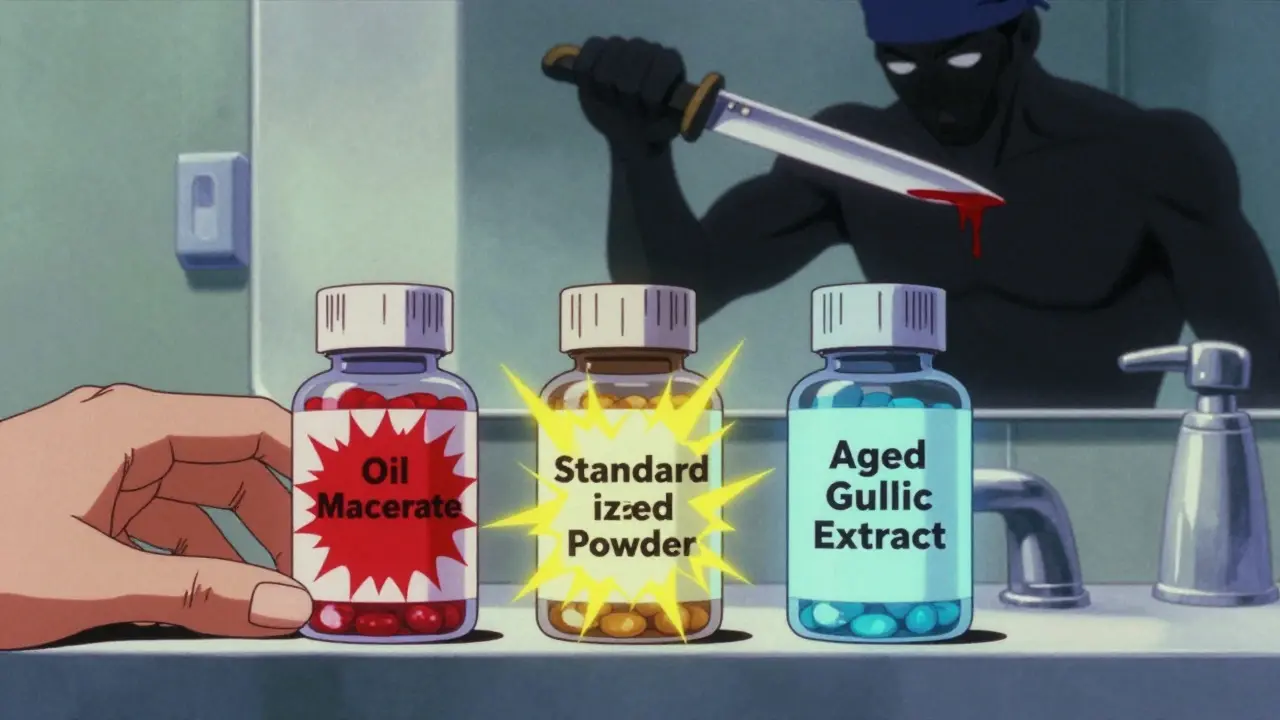
Here’s where things get tricky. Not every garlic pill has the same effect. The amount of ajoene depends entirely on how the supplement is made.
- Oil macerates (garlic soaked in oil) have the highest ajoene-up to 1.0 mg per gram. These are the most dangerous.
- Standardized dried powder (common in capsules) has about 0.1-0.3 mg per gram. Still enough to matter.
- Aged garlic extract (like Kyolic) has almost no ajoene. It’s processed to remove the antiplatelet compounds. This might be the only safe option if you’re on blood thinners.
But here’s the problem: labels don’t tell you which kind you’re getting. The FDA doesn’t require manufacturers to list ajoene content. A 2019 test by ConsumerLab.com found some brands had 15 times more active ingredient than others. You could be taking two identical-looking pills and one could be 15 times more likely to cause bleeding.
Who’s at the Highest Risk?
You don’t have to be a senior to be at risk. But if you’re over 65 and on a blood thinner, you’re in a high-risk group. A 2022 national survey found that nearly 1 in 5 older adults take garlic supplements. Of those, over 22% are also on anticoagulants. That’s over 3 million Americans combining two potentially dangerous things without knowing it.
Some situations are especially risky:
- Before surgery-even minor ones. A 2017 study found 68% of patients kept taking garlic supplements right up until their procedure, despite being asked about herbal products. One patient had a colon surgery turned into an emergency open procedure because his tissues wouldn’t stop oozing blood.
- Dental work-extractions or gum surgery. Bleeding that won’t stop is common in these cases.
- Neurosurgery or spinal procedures-a single bleed in the spine can cause paralysis.
- Prostate surgery-a 2001 case report described four hours of bleeding after a simple procedure, all because of garlic.
And here’s the kicker: most people don’t even think of garlic as a supplement. They say, “I just eat garlic.” But when it’s in pill form, the dose is concentrated. One capsule can equal 5,000 mg of fresh garlic. That’s 10 cloves. No one eats 10 cloves a day. But they take one pill.
What the Experts Say
Dr. Pieter Cohen from Harvard Medical School says garlic supplements can increase the effects of blood thinners-leading to bleeding-and also interfere with cholesterol and blood pressure meds. The American Heart Association doesn’t mince words: they advise extreme caution, citing documented cases of serious bleeding.
The American Society of Anesthesiologists went further. In their 2022 guidelines, they labeled garlic a “high-risk herbal product” and said patients should stop taking it 14 days before any surgery. The European Society of Anaesthesiology says 7 days is enough. That’s a big difference-and it shows how inconsistent the advice still is.
But the evidence is clear. Multiple studies confirm garlic’s antiplatelet effect. A 1996 trial showed a 20-40% drop in platelet activity. A 1998 case series showed INR spikes in warfarin users. And in 2019, a spinal hematoma was directly linked to 2,400 mg of daily garlic. That’s not a fluke. It’s a pattern.
What Should You Do?
If you’re on a blood thinner:
- Stop taking garlic supplements-no exceptions. Even if you feel fine. The damage is silent until it’s too late.
- Talk to your doctor-not your pharmacist, not your friend who “swears by garlic.” Ask specifically: “Is my garlic supplement safe with my blood thinner?”
- Check the label-if it says “aged garlic extract,” it’s likely safer. If it says “garlic powder,” “oil,” or “standardized extract,” assume it’s risky.
- Don’t assume natural means safe-garlic is natural. So is poison ivy.
- Wait 7-14 days before surgery-follow your surgeon’s advice. If they don’t ask about supplements, tell them anyway.
If you’re not on blood thinners but take garlic supplements, still be cautious. If you start one later-especially if you’re over 50-talk to your doctor first. And if you’ve ever had unexplained bruising, nosebleeds, or prolonged bleeding after a cut, stop taking garlic and get checked.

Why This Isn’t Getting More Attention
Garlic supplements are a $1.27 billion industry. Most brands don’t warn you because they don’t have to. Only 42% of manufacturers follow FDA labeling guidelines. Only 37% even link to the NIH’s interaction database. And patients? A 2022 survey found 83% didn’t know garlic could interact with blood thinners. Two out of three never told their doctor.
It’s not just ignorance. It’s a system failure. We treat supplements like vitamins. But they’re not. They’re active drugs with real, measurable, dangerous effects. And when they mix with prescription meds, the consequences aren’t hypothetical. They’re written in hospital charts.
What’s Changing
The FDA is working on new rules. Draft guidance in 2023 requires garlic supplements to list ajoene content. Final rules are expected by mid-2024. Some companies are already responding. Kyolic now markets its aged extract as “ajoene-free,” claiming 98% less antiplatelet activity. But until those labels are required, you can’t trust them.
The NIH is funding a $2.4 million study to measure exactly how much garlic increases bleeding risk with apixaban. Results are due in late 2024. Until then, the safest choice is simple: don’t take garlic supplements if you’re on blood thinners.
There’s no magic number. No safe dose. No “just one pill.” If you’re on warfarin, Eliquis, Xarelto, or any other anticoagulant, garlic supplements aren’t a health boost. They’re a hidden risk-and one that could cost you your life.






Ivan Viktor
March 4, 2026 AT 21:22Zacharia Reda
March 6, 2026 AT 03:25Donna Zurick
March 7, 2026 AT 03:52Tobias Mösl
March 7, 2026 AT 13:51tatiana verdesoto
March 8, 2026 AT 10:01Ethan Zeeb
March 10, 2026 AT 05:14Darren Torpey
March 11, 2026 AT 04:03Mariah Carle
March 13, 2026 AT 03:26Justin Rodriguez
March 14, 2026 AT 10:40Siri Elena
March 15, 2026 AT 19:49Divya Mallick
March 16, 2026 AT 17:01Pankaj Gupta
March 17, 2026 AT 05:19Alex Brad
March 19, 2026 AT 02:22