
Benzodiazepine-Opioid Risk Calculator
Understanding the Risk
When combined, opioids and benzodiazepines multiply respiratory depression risk. In 2019, nearly 1 in 6 opioid overdose deaths involved benzodiazepines. Concurrent use increases overdose risk by 10x compared to opioids alone.
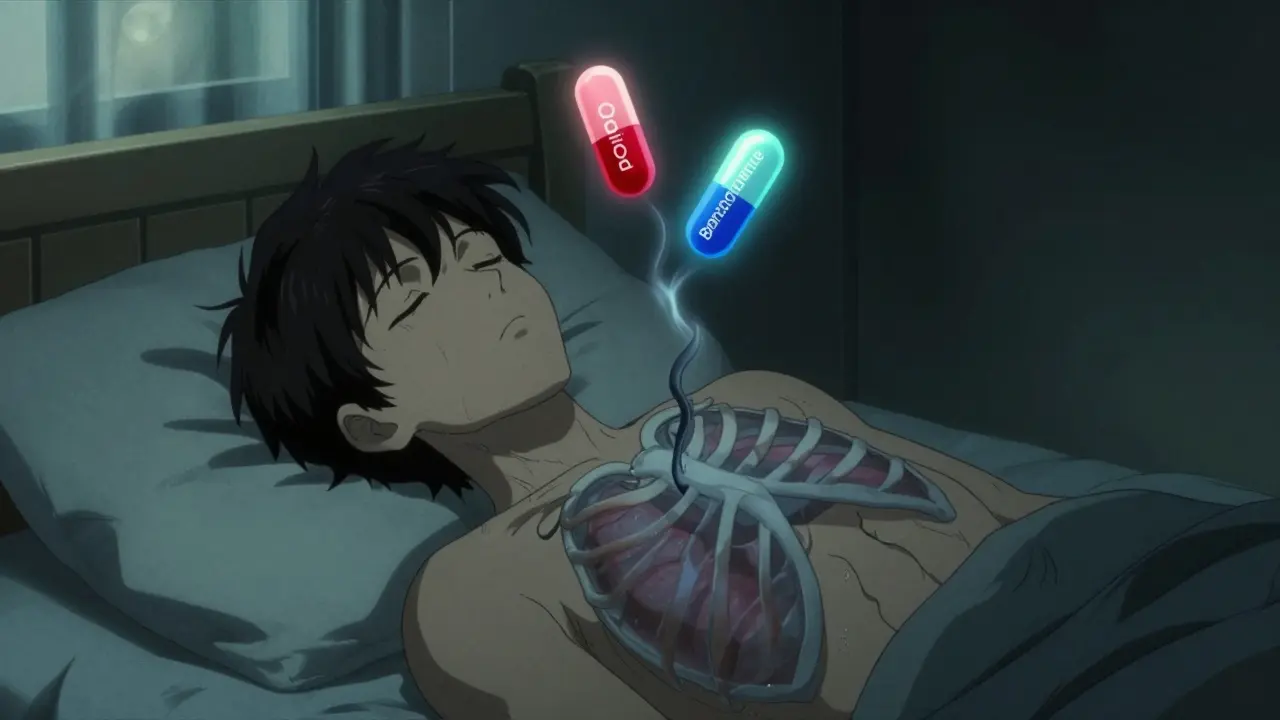
When you take an opioid for pain and a benzodiazepine for anxiety, you might think you’re just managing two separate problems. But what you’re really doing is putting your breathing at risk-seriously, life-threateningly at risk. The combination doesn’t just add up. It multiplies. And the result? A dangerous slowdown-or even a complete stop-of your breathing. This isn’t a hypothetical danger. It’s happening right now, in homes, hospitals, and emergency rooms across the country. In 2019, nearly 1 in 6 opioid overdose deaths involved benzodiazepines. That’s not a coincidence. It’s a predictable, preventable tragedy.
How These Drugs Kill Your Breathing
Opioids like oxycodone, hydrocodone, or fentanyl work by binding to mu-opioid receptors in your brainstem. That’s the part of your brain that controls automatic functions like breathing. When these receptors get activated, they mess with the rhythm of your breath. Specifically, they make each exhale longer and push your body toward pauses between breaths. Research shows this happens because opioids hit two key areas: the Kölliker-Fuse/Parabrachial complex (KF/PB), which controls how long you exhale, and the preBötzinger Complex, which sets your inhale rhythm. At high doses, these areas go quiet. You stop breathing-not because you’re asleep, but because your brain no longer tells your lungs to move. Benzodiazepines like diazepam, alprazolam, or lorazepam work differently, but they end up in the same place. They boost GABA, the brain’s main calming chemical. This calms you down-too much. In the brainstem, that means extra inhibition of the very neurons that keep you breathing. Alone, a standard dose might make you a little drowsy. But when you mix it with an opioid, the two drugs don’t just add together. They amplify each other. One study showed that combining fentanyl and midazolam cut minute ventilation by 78%. Fentanyl alone? 45%. Midazolam alone? 28%. That’s not linear. That’s exponential.The Numbers Don’t Lie
The CDC found that people prescribed both opioids and benzodiazepines are 10 times more likely to die from an opioid overdose than those taking opioids alone. Between 2010 and 2021, opioid overdose deaths jumped from 21,000 to over 80,000. And in three out of four of those cases, other drugs were involved. Benzodiazepines were the most common co-drug. The highest rates? People aged 45 to 64. Often, they’re on long-term pain meds and prescribed benzodiazepines for anxiety or insomnia. Doctors didn’t always warn them. Patients didn’t know. The FDA saw this coming. In 2016, they slapped a black box warning on both drug classes-the strongest possible alert. It said: “Concurrent use increases the risk of respiratory depression, sedation, coma, and death.” Between 2004 and 2011, emergency room visits from people mixing these drugs jumped by 131%. Even after the warning, a 2022 study found that nearly 9% of long-term opioid patients were still getting both drugs together. That’s not just outdated prescribing. That’s negligence.Why Doctors Still Prescribe Both
It’s not because they’re careless. It’s because they’re stuck. Many patients with chronic pain also have anxiety, PTSD, or insomnia. Benzodiazepines work fast. SSRIs and buspirone? They take weeks. So doctors reach for what’s quick. But quick isn’t safe. And in this case, it’s deadly. The American Society of Anesthesiologists says this combination should be avoided whenever possible. The CDC’s 2016 opioid prescribing guidelines say the same. But guidelines don’t always reach the clinic. Some doctors don’t check prescription drug monitoring programs (PDMPs). Others assume “low doses” are safe. They’re not. There’s no safe threshold when these drugs mix. Even small amounts can tip someone into respiratory arrest, especially if they’re older, have lung disease, or use alcohol.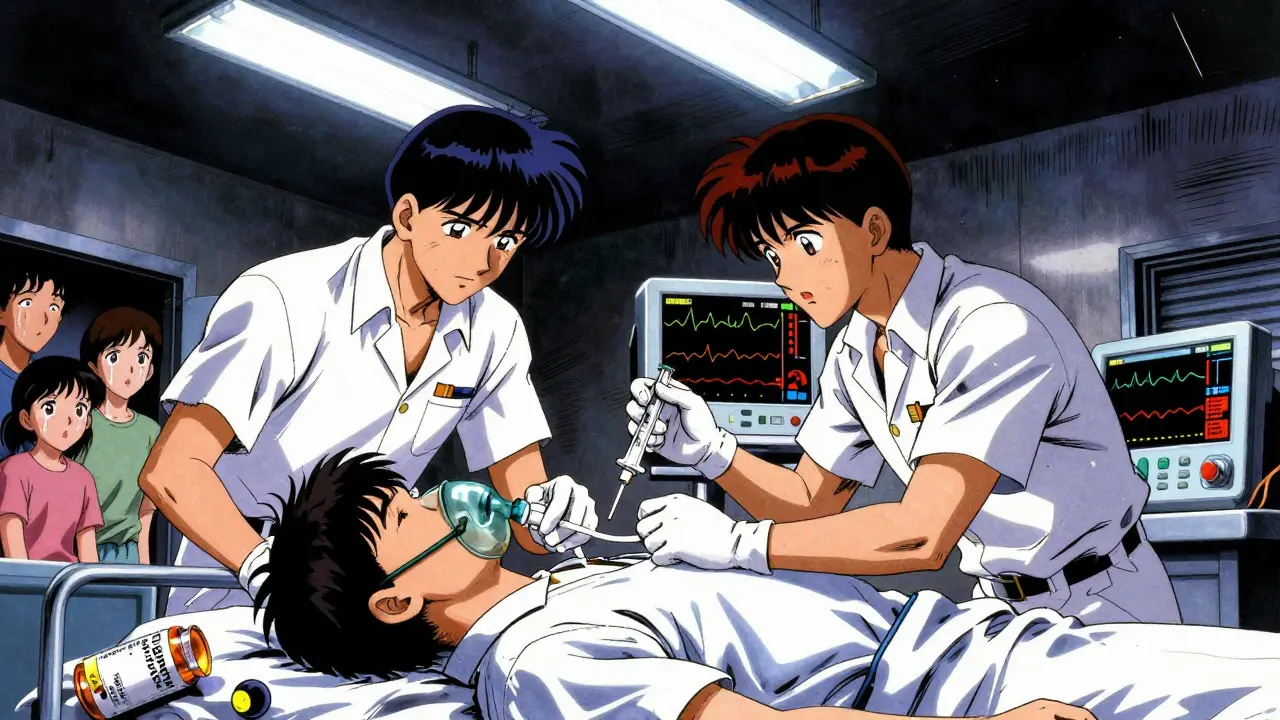
What Happens When You Overdose
If someone overdoses on opioids alone, naloxone (Narcan) can reverse it. Fast. Effective. Life-saving. But naloxone does nothing for benzodiazepines. So if someone overdoses on both, naloxone might wake them up-but their breathing might still be too weak. They could slip back into respiratory failure minutes later. That’s why emergency responders now carry naloxone and monitor breathing for hours after a mixed overdose. It’s not enough to reverse the opioid. You have to support the breathing until the benzodiazepine wears off. There’s no antidote for benzodiazepine-induced respiratory depression. Flumazenil can reverse the sedation, but it’s risky-it can trigger seizures in people dependent on benzodiazepines. And it doesn’t fix the opioid part. So treatment is mostly supportive: oxygen, ventilation, waiting. It’s brutal. And it’s avoidable.What You Can Do Instead
If you’re on opioids for pain and struggling with anxiety or sleep, there are safer options. For anxiety, SSRIs like sertraline or escitalopram take time but don’t suppress breathing. CBT (cognitive behavioral therapy) works better than pills for long-term anxiety. For insomnia, sleep hygiene, melatonin, or even low-dose trazodone are safer than benzodiazepines. For pain, non-opioid options like gabapentin, physical therapy, or acupuncture can reduce or eliminate the need for opioids. If you absolutely need both drugs-for example, in end-of-life care or severe seizure disorders-then the rules are simple: use the lowest possible dose. For the shortest possible time. Monitor closely. No alcohol. No other sedatives. And never, ever take extra doses because you feel “not enough.” That’s how it ends.


Shruti Badhwar
January 3, 2026 AT 19:44This is one of those topics that gets buried under noise, but the data here is undeniable. I work in public health in India, and we’re seeing a quiet surge in polypharmacy cases-especially among elderly patients with chronic pain and insomnia. Doctors prescribe benzodiazepines like they’re vitamins, and patients don’t question it. No one talks about the breathing risk. We need mandatory CME modules on this. Not optional. Mandatory.
Brittany Wallace
January 4, 2026 AT 19:35It’s heartbreaking how we’ve turned healing into a chemical balancing act 🫂. We treat symptoms like puzzles to solve, not signals to listen to. What if we stopped reaching for pills the second anxiety or pain showed up? What if we made space-for therapy, for walks, for silence? The body knows how to heal. We just forgot to let it.
Lori Jackson
January 6, 2026 AT 02:44Let’s be unequivocally clear: this is a catastrophic failure of clinical governance. The confluence of pharmacodynamic synergism and prescriptive negligence constitutes a public health malfeasance of the highest order. The FDA’s black box warning was a tepid gesture-what we require is systemic de-prescribing protocols, algorithmic PDMP enforcement, and punitive measures against providers who persist in polypharmacy. This isn’t ‘bad prescribing.’ It’s bioethical dereliction.
Angela Goree
January 6, 2026 AT 06:56AMERICA IS DYING FROM WEAKNESS!! We let doctors hand out pills like candy!! People are too lazy to get real help-therapy, exercise, discipline!! Now we’re paying with OUR LIVES!! STOP GIVING OUT DRUGS!! STOP!!
sharad vyas
January 6, 2026 AT 23:13In India, many older people are given these drugs because families don’t know what else to do. No one talks about it. No one asks. I’ve seen grandparents on lorazepam and tramadol, and no one checks if they’re breathing right at night. We need community health workers to ask the right questions-not just hand out scripts.
Dusty Weeks
January 7, 2026 AT 19:22my dr gave me xanax and oxy after my back surgery… i didnt know it was a bad combo until i read this. i’m scared. 🥲
Sally Denham-Vaughan
January 9, 2026 AT 17:21Thank you for writing this. I’ve been on gabapentin for nerve pain and sertraline for anxiety for two years now. I used to be on Klonopin and hydrocodone-felt like a zombie. Switching wasn’t easy, but my breathing is better, my brain is clearer, and I actually sleep through the night now. It’s possible. It’s not fun, but it’s worth it.
Bill Medley
January 11, 2026 AT 16:27Respiratory depression is a pharmacokinetic synergy that exceeds additive risk. The clinical imperative is clear: avoid concurrent use. Evidence-based guidelines exist. Implementation remains inconsistent.
Hank Pannell
January 12, 2026 AT 09:17This is where the medical model breaks down. We’re treating depression as a neurotransmitter deficiency, pain as a receptor malfunction, and sleep as a hormonal glitch. But what if these are symptoms of deeper disconnection? Loneliness, trauma, chronic stress? The drugs don’t fix the root-they just mute the alarm. And when the alarm’s silenced, the house burns down. We need systems that heal environments, not just neurons.
Ian Ring
January 14, 2026 AT 00:22I’ve been a GP in Manchester for 22 years… I’ve seen this too many times. The system pushes for quick fixes-10-minute appointments, prescription quotas, insurance pressures. I used to prescribe both. Now I don’t. I refer to physio, I book CBT slots, I say ‘Let’s try this for six weeks first.’ It’s harder. But lives are worth the effort.