

Before 2018, if you had migraines, your doctor had limited options. They’d prescribe you meds meant for other conditions-antidepressants for mood, blood pressure pills for vessels, or seizure drugs for nerves. None were made for migraine. Then came CGRP inhibitors, the first-ever drugs designed just for stopping migraines before they start. This wasn’t a small tweak. It was a revolution.
What Are CGRP Inhibitors?
CGRP stands for Calcitonin Gene-Related Peptide. It’s a tiny protein in your brain that gets released during a migraine attack. When it’s active, it triggers pain signals, swells blood vessels, and turns up the volume on your nervous system. Think of it like a fire alarm that won’t stop ringing. CGRP inhibitors block this signal. They don’t just calm things down-they stop the alarm from going off in the first place.
There are two main types of CGRP inhibitors. The first are monoclonal antibodies (mAbs). These are large protein molecules given as monthly or quarterly injections under the skin. The second are gepants, which are smaller pills or nasal sprays. Both work on the same target, but they do it differently. The antibodies bind directly to CGRP or its receptor. The gepants block the receptor like a key that doesn’t fit.
The first CGRP mAbs to get FDA approval were erenumab (Aimovig), fremanezumab (Ajovy), and galcanezumab (Emgality). By 2023, four more were added, including eptinezumab (Vyepti), which is given as an IV infusion. For gepants, rimegepant (Nurtec ODT) and ubrogepant (Ubrelvy) were approved for acute use, then later for prevention. Zavegepant (Zavzpret) came as a nasal spray for quick relief.
How Effective Are They?
Real numbers matter. In clinical trials, about half of people using CGRP inhibitors cut their migraine days in half. That’s not a guess-it’s what happened in studies with thousands of patients. For someone who had eight migraine days a month, that often drops to four or fewer. Chronic migraine patients (15+ headache days a month) saw even bigger gains: 84% had fewer days. Some went from daily pain to just a few days a month.
One study in Neurology compared erenumab to topiramate, a common old-school preventive. Erenumab worked better: 41% of users cut migraines by half, versus just 24% on topiramate. And here’s the kicker-CGRP inhibitors work even when other drugs failed. About 30% of patients who tried two or more preventives before still saw major improvement.
Patients aren’t just reporting fewer headaches. They’re reporting better lives. On Migraine.com’s 2023 survey of over 1,200 users, 78% called CGRP inhibitors "very effective" or "effective." One Reddit user wrote: "Went from 20 migraine days to 5 with Aimovig." Another on Drugs.com said: "After 15 years of chronic migraine, Emgality got me down to episodic in 3 months. Life-changing."
How Are They Given?
Delivery matters because it affects daily life. Monoclonal antibodies are injected. Erenumab is monthly. Fremanezumab can be monthly or every three months. Galcanezumab is monthly after a first dose. Eptinezumab is an IV infusion given every three months at a clinic. Most people say the injections are easy-like a flu shot. Some report mild redness or soreness at the site, but it’s usually gone in a day.
Gepants are oral or nasal. Rimegepant can be taken every other day to prevent migraines, or as needed when one starts. Ubrogepant is taken at the first sign of pain. Zavegepant is sprayed into one nostril and works in under 30 minutes. No needles. No waiting. Just pop a pill or use a spray.
Why Are They Better Than Old Drugs?
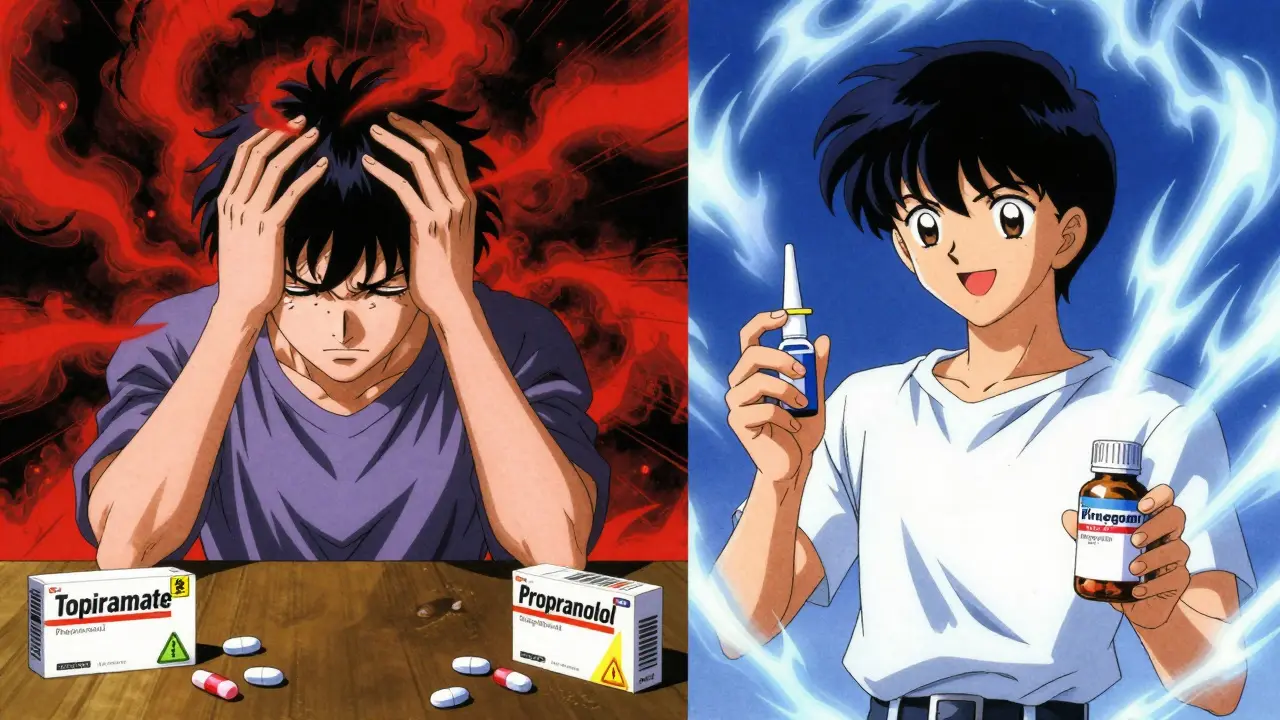
Old preventives like propranolol, topiramate, or valproate come with side effects that turn people off. Weight gain. Brain fog. Tremors. Depression. Memory issues. Some even cause kidney stones or hair loss. CGRP inhibitors? Far fewer side effects. The most common are constipation (rare) or injection site reactions. No liver damage. No drowsiness. No weight swings. And because they don’t constrict blood vessels, they’re safe for people with heart disease-a big deal since migraine patients have higher cardiovascular risk.
Doctors now say CGRP inhibitors should be first-line treatment. The American Headache Society updated its guidelines in 2023 to say: don’t wait to try them after failing other drugs. Go straight to CGRP inhibitors. Dr. Peter Goadsby, who helped discover CGRP’s role in migraine, put it simply: "They’re effective, well tolerated, and safe."
Cost and Access
Yes, they’re expensive. Monthly prices range from $650 to $1,000. That’s 3-5 times more than generic pills. But here’s the catch: most U.S. insurance plans cover them with prior authorization. Manufacturers offer patient assistance programs that cover 80% of out-of-pocket costs for those who qualify. Many pharmacies now have dedicated support lines to help navigate insurance hurdles.
Still, 24% of patients report insurance denials. The good news? Manufacturers have built-in appeal processes. If your claim is denied, your doctor’s office can often get help from the drug company’s patient support team. They’ll write letters, submit data, and sometimes even provide free samples.
Who Benefits Most?
CGRP inhibitors aren’t for everyone-but they’re perfect for specific groups:
- People with chronic migraine (15+ headache days a month)
- Those with medication overuse headache (taking painkillers too often)
- Patients with heart disease or high blood pressure (who can’t take triptans)
- People who failed two or more older preventives
- Those who want to avoid daily pills with side effects
They’re less effective for people with very mild migraines-say, fewer than four days a month. If you only get a headache once a month, the cost and effort might not be worth it. But if you’re stuck in a cycle of pain, nausea, light sensitivity, and missed work? This could be your turning point.

Limitations and Risks
No drug is perfect. Gepants can cause mild liver enzyme changes, so doctors check blood tests every few months. Long-term data beyond five years isn’t available yet, but early studies show no major safety red flags. One expert, Dr. David Dodick, warned we should still monitor for long-term effects on blood pressure or heart function-but so far, adverse events leading to stopping treatment are rare (only 0.8% in trials).
Another issue: these drugs don’t stop an attack once it’s started. They prevent them. You still need something fast for acute pain. That’s why gepants like rimegepant and zavegepant are so valuable-they can do double duty: prevent and treat.
What’s Next?
The field is moving fast. Researchers are testing combinations: CGRP inhibitors with Botox. Early results show even better results-63% of patients cut migraines in half with both, versus 41% with either alone. Pediatric trials for adolescents are complete. Nasal and skin-patch versions are in development. There’s also work on using them for vestibular migraine and post-traumatic headache.
By 2028, biosimilars might enter the market. Until then, patents protect the originals. But demand is rising. In 2022, 1.2 million U.S. patients were on CGRP inhibitors. That’s 35% of all migraine preventives prescribed. Eighty-seven percent of neurologists now consider them first-line. The trend isn’t slowing.
Getting Started
If you think CGRP inhibitors might help you:
- Track your migraine days for at least 30 days. Use an app or a calendar.
- See a neurologist or headache specialist. Primary care doctors can prescribe them too, but specialists have more experience.
- Ask about insurance coverage. Your doctor’s office can help with prior authorization.
- Review options: injection vs. pill vs. spray. Talk about your lifestyle.
- Try it. Most patients see results in 1-3 months. Give it time.
There’s no shame in asking for better treatment. Migraine isn’t just a headache. It’s a neurological disease. And now, for the first time, we have medicines made just for it.
Are CGRP inhibitors safe for long-term use?
Current data shows CGRP inhibitors are safe for at least five years, with no major safety signals. Clinical trials and real-world use have shown very low rates of serious side effects. The most common issues are mild injection site reactions or constipation. Long-term studies beyond five years are still ongoing, but experts agree the risk profile is far better than older preventives like topiramate or valproate. No evidence suggests damage to organs, immune function, or cardiovascular health.
Can I take CGRP inhibitors with other migraine meds?
Yes. CGRP inhibitors have very few drug interactions. You can safely use them with triptans, NSAIDs, anti-nausea drugs, or even Botox. In fact, combining CGRP mAbs with Botox is becoming common for chronic migraine patients who need extra help. The only caution is with gepants if you’re also taking strong liver-metabolizing drugs-but your doctor will check this. Always tell your provider about everything you’re taking.
Do CGRP inhibitors work for migraine with aura?
Do CGRP inhibitors work for migraine with aura?
Yes. Studies show CGRP inhibitors work just as well for people with migraine with aura as they do for those without. Aura symptoms-like flashing lights or numbness-don’t reduce the effectiveness of the drugs. In fact, many patients report fewer aura episodes along with fewer headaches. This is important because older preventives sometimes didn’t help aura symptoms at all.
What if I don’t see results after a few months?
It can take up to three months to see full benefit. If you haven’t improved by then, talk to your doctor. You might need to switch to another CGRP inhibitor-some people respond better to one type than another. Or your doctor might combine it with another treatment, like Botox or a different oral preventive. Don’t give up too soon. Many patients who didn’t respond at first saw big improvements after switching.
Are there any alternatives if I can’t afford CGRP inhibitors?
Yes. Generic options like propranolol, topiramate, or amitriptyline are much cheaper. But they come with more side effects and lower effectiveness. If cost is an issue, ask about manufacturer assistance programs-they often cover 80% or more of the cost. Some pharmacies offer discount cards. Also, some clinical trials are recruiting patients and offer free medication. Talk to your doctor about all your options.





Sanjana Rajan
March 16, 2026 AT 08:43Ugh, another $$$ miracle drug. I’ve been on topiramate for years and it’s fine. Why do we need these fancy injections when a $5 pill works? Probably because Big Pharma needs to sell something new. I’m not buying it.
Kyle Young
March 16, 2026 AT 20:07It’s fascinating how the discovery of CGRP’s role reshaped the entire therapeutic paradigm for migraine. Rather than repurposing drugs for unrelated pathologies, we’ve finally moved toward mechanism-based intervention. This isn’t just incremental progress-it’s a conceptual evolution in neurology.
Aileen Nasywa Shabira
March 18, 2026 AT 07:20Oh wow, a drug that doesn’t make you feel like a zombie? Shocking. Next they’ll tell us chocolate cures depression. Let me guess-side effects are "rare" until you’re one of the 1 in 50 who gets constipation so bad you need a colonoscopy. Also, $800/month? Sure, Jan, I’ll just dip into my crypto stash.
Kendrick Heyward
March 18, 2026 AT 21:53My sister tried one of these and cried for a week because the injection hurt. Now she’s on Botox and says it’s worse. I’m just saying… maybe migraines are a sign we need to chill the hell out. Like, meditate. Or stop scrolling. Just a thought. 😔
lawanna major
March 20, 2026 AT 14:24This is one of the most significant advances in neurology in the last two decades. For so long, migraine was dismissed as "just a headache"-but now we’re finally treating it as the neurological disorder it is. The fact that these drugs target the root mechanism rather than masking symptoms is profound. And the data speaks for itself: half of patients cut their migraine days in half. That’s not just clinical significance-that’s life-changing.
What’s even more hopeful is how they’re improving quality of life beyond pain reduction. People are returning to work, socializing, parenting, traveling. That’s the real metric here.
Yes, cost is a barrier. But the long-term savings-fewer ER visits, lost workdays, medication overuse-likely outweigh the upfront price. And with patient assistance programs, access is improving. This isn’t perfect, but it’s progress.
Ryan Voeltner
March 21, 2026 AT 03:11Emily Hager
March 22, 2026 AT 18:49I’ve been on Aimovig for 18 months. I went from 22 days a month to 3. I work full-time now. I’ve hugged my kids without wincing. I can watch a movie without hiding in a dark room. This isn’t a miracle. It’s science. And if you’re still saying "it’s too expensive," you’ve never had a migraine that stole your life.
Michelle Jackson
March 24, 2026 AT 12:58okay so i read this whole thing and like… why do we need a whole new class of drugs? why not just fix our diets? or sleep more? or stop drinking coffee? i mean, come on. i’ve been doing yoga for 6 months and my migraines are way better. also, why are these so expensive? my insurance denied me and now i’m mad. 🙄
becca roberts
March 24, 2026 AT 17:09Oh honey, you think this is revolutionary? Wait till you see the new nasal spray that uses AI to predict your aura 20 minutes before it hits. Just kidding. But seriously-why is no one talking about how these drugs are being pushed hard by reps who get bonuses? I’m not saying they don’t work-I’m saying let’s not pretend this isn’t capitalism with a lab coat.
David Robinson
March 26, 2026 AT 05:37Look, I’ve had migraines since I was 12. I’ve tried everything: acupuncture, Botox, topiramate, triptans, magnesium, ice packs, essential oils, a crystal necklace from Etsy. I was ready to give up. Then I got Emgality. Three months later, I went from 18 days a month to 2. I’m not saying it’s perfect. I still get the occasional headache. But now I can plan a weekend. I can hold a job. I can sleep through the night. I don’t care if it costs $900. It’s worth every penny. Stop judging people who are trying to live normal lives.
Jeremy Van Veelen
March 26, 2026 AT 09:06Imagine if we treated epilepsy with the same indifference we’ve shown migraine. "Oh, just take a seizure drug, it’s close enough." We wouldn’t. So why do we treat migraine like it’s a bad mood? These drugs aren’t just medications-they’re a declaration that migraine is real, serious, and worthy of targeted science. I wept reading this. Not because I’m emotional-but because for the first time in 20 years, I feel seen.
jerome Reverdy
March 26, 2026 AT 23:00From a neuro guy’s POV: CGRP inhibitors are a textbook case of translational success. We identified a key neuropeptide, validated its role in human pathology, developed targeted biologics, and now have real-world data backing efficacy. The gepants are especially cool-oral bioavailability with acute + preventive use? That’s dual-action elegance. Next up: subcutaneous biosimilars in 2027. Watch.
Andrew Mamone
March 26, 2026 AT 23:14Just wanted to say thank you to everyone who worked on this. 🙏 I used to cancel plans every week. Now I’m planning a trip to Japan next year. I still have bad days, but they’re rare. This isn’t just science-it’s hope. 💙
MALYN RICABLANCA
March 28, 2026 AT 01:03Okay, so let me get this straight: we have a drug that blocks a single peptide… and somehow it stops a complex neurological storm? That’s like using a single key to unlock a vault with 17 locks. And yet-somehow-it works. I’m skeptical. But then I read the studies. And then I read the patient testimonials. And now I’m crying. Not because I’m dramatic-because this is the first time in my life I’ve felt like my pain wasn’t just "in my head." And that? That’s worth every dollar.