
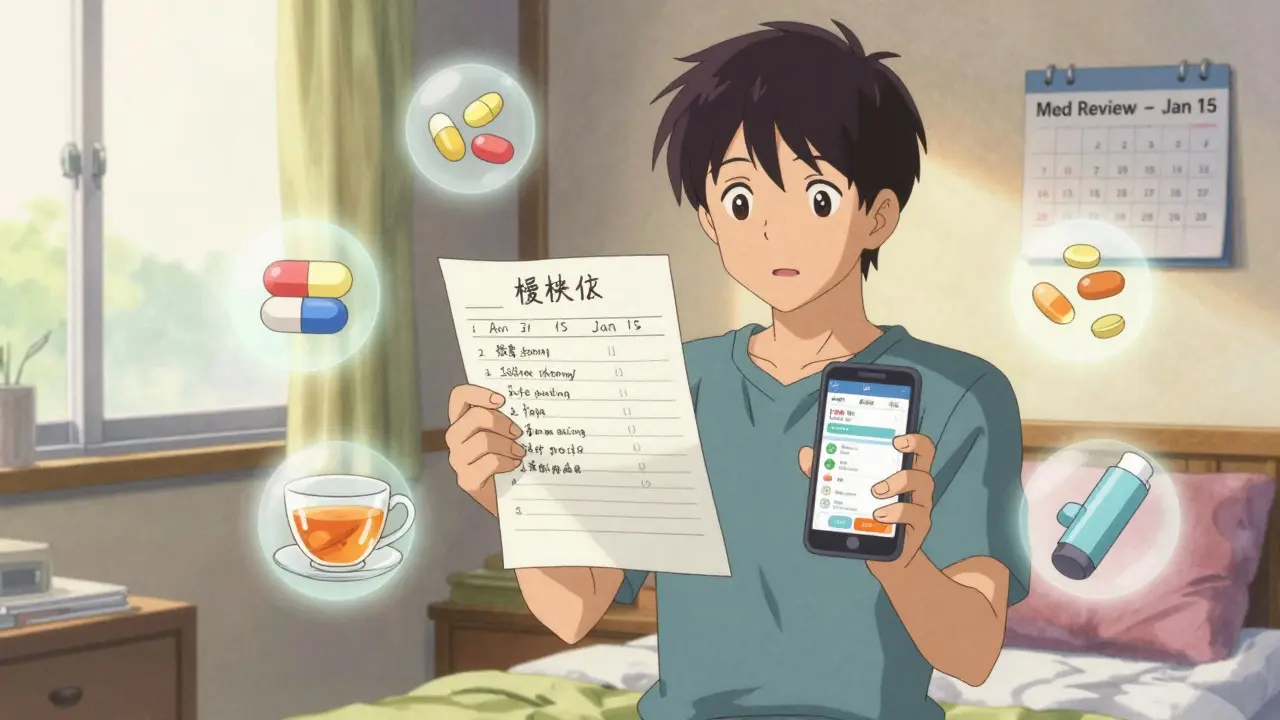
Getting your medications right isn’t just about taking pills on time. It’s about making sure every doctor, pharmacist, and nurse who treats you knows exactly what you’re taking - and why. A complete medication list is one of the simplest, most powerful tools you have to avoid dangerous mistakes. And it’s not just for older adults or people with complex health issues. If you take even one prescription, an over-the-counter painkiller, a vitamin, or an herbal supplement, you need a clear, up-to-date list.
Why Your Medication List Matters More Than You Think
Every year in the U.S., over 1.5 million people are harmed by medication errors. Half of those happen when patients move between care settings - from hospital to home, from primary care to specialist, or even during an emergency room visit. The biggest reason? Incomplete or inaccurate medication lists.
When you’re admitted to a hospital, staff are supposed to check your meds against what’s in your chart. But if you can’t remember everything you take - or worse, if you forgot to mention your daily fish oil or your grandma’s herbal tea for sleep - they might miss something critical. That’s how dangerous interactions happen. A blood thinner mixed with an herbal supplement? A kidney medication doubled because the doctor didn’t know you were already taking it? These aren’t rare. They’re preventable.
Research from Harvard Medical School shows patients who keep a full, accurate list reduce their risk of serious adverse drug events by 43%. That’s not a small number. That’s life-changing.
What Belongs on a Complete Medication List
A simple note like “blood pressure pill” isn’t enough. You need details. Here’s what every entry must include:
- Medication name - both brand and generic (e.g., “Lisinopril (Zestril)”)
- Dosage - exactly how much you take (e.g., “10 mg,” not “one pill”)
- How and when to take it - “once daily with breakfast,” “as needed for pain, up to 3 times a day”
- Why you’re taking it - “for high blood pressure,” “for arthritis pain,” “for anxiety”
- When you started - even approximate dates help
- Who prescribed it - doctor’s name or clinic
- Refill status - “last refill: Jan 5, 2026,” “out of stock”
Don’t forget the extras:
- Over-the-counter meds (ibuprofen, antacids, sleep aids)
- Vitamins and supplements (vitamin D, magnesium, CoQ10)
- Herbal remedies (turmeric, echinacea, St. John’s wort)
- Topical treatments (creams, patches, eye drops)
- Inhalers and nasal sprays
- Allergies - list the exact reaction (e.g., “amoxicillin - hives and swelling,” not just “allergic to penicillin”)
And if you’re on a PRN (as-needed) medication, write down how often you’ve used it in the last week. That helps your doctor spot patterns.
How to Keep It Updated - And Actually Use It
A list that’s outdated is worse than no list at all. Here’s how to keep yours current:
- Update it immediately - Every time you start, stop, or change a dose, write it down right away. Don’t wait for your next appointment.
- Review it monthly - Set a calendar reminder. Go through each item. Are you still taking it? Does it still make sense?
- Bring it to every visit - Even if your doctor says, “We have your records.” They might not. Or they might be looking at the wrong version.
- Use a template - The FDA’s “My Medicines” guide offers a simple, printable format. Use it. Or download a trusted app like GoodRx, Medisafe, or MyTherapy.
Many people think they’ll remember everything. But studies show that 73% of patient-reported lists miss at least one important medication. Memory is unreliable. Paper or digital - write it down.
Paper vs. Digital: Which Is Better?
You don’t need fancy tech. A handwritten list on a piece of paper works - if it’s legible and always with you. Sixty-eight percent of patients still use paper, according to the National Council on Aging. But here’s the catch: if it’s in your purse and you forget your purse, you’re back to square one.
Digital tools offer backup, reminders, and easy sharing. Apps can send alerts when it’s time to refill or take a dose. Many let you share your list directly with your doctor’s portal. Practices using EHR-integrated apps see 40% higher patient compliance.
Best approach? Do both. Keep a printed copy in your wallet or purse. Keep a digital copy synced across your phone, tablet, and cloud storage. Take a screenshot and email it to a trusted family member.
For complex regimens - five or more medications - color-code them. Red for heart meds, blue for pain, green for supplements. Add small icons (💊 for pills, 🧴 for cream, 💨 for inhaler). A study from Advanced Psychiatry Associates found this boosted adherence by 27%.
Make It Part of Your Routine - Not an Emergency Task
Don’t wait until you’re in the ER or about to be admitted to the hospital to create your list. That’s too late.
Instead, treat it like your annual checkup. Every January, schedule a 30-minute “medication review” with your primary care provider. Bring your list. Ask: “Are all of these still necessary?” “Is there anything I can stop?” “Are there cheaper or safer alternatives?”
Doctors who use this approach report saving over 2.7 hours per day by cutting down on unnecessary refill requests. And patients? They’re less likely to be hospitalized for medication problems. One study found that patients who followed a consistent list-keeping routine reduced medication-related hospital visits by 31%.
What to Do When Things Change
Life happens. You get a new prescription. You stop taking something. Your pharmacist switches your brand. Your doctor adds a new one.
When that happens:
- Write it down immediately - don’t rely on memory
- Update both your paper and digital copies
- Call your pharmacy to confirm the change is in their system
- Send a copy to your primary doctor via secure messaging or email
- Let a family member or caregiver know
If you’re switching doctors or moving to a new care facility, bring your list with you - and ask them to verify it against your pharmacy records. Don’t assume they’ll do it for you.
The Bigger Picture: Why This Isn’t Just Your Job
Health systems are starting to catch up. By 2027, federal rules will require all major health systems to give patients direct, real-time access to their full medication records. Right now, 92% of them already do - but only 42% let you edit or maintain your own version.
That’s changing. The 21st Century Cures Act and new HL7 FHIR standards are making it easier for your list to flow between your phone, your pharmacy, and your doctor’s system. But none of that matters if you don’t keep your list accurate.
Medication safety isn’t just about hospitals or tech. It’s about you. You’re the only person who knows what you actually take - and when. Your list is your shield. Keep it sharp.
Start Today - No Matter How Simple Your Regimen
You don’t need to be on ten medications to benefit. Even if you only take one pill a day, a complete list protects you. It gives you control. It gives your care team clarity. And in a system where mistakes are common, that’s priceless.
Right now, grab a pen and paper. Or open your phone. Write down everything you take - every pill, drop, patch, and supplement. Don’t skip the “tiny” stuff. Don’t assume it doesn’t matter. Include the ibuprofen you take for headaches. The melatonin you use when you can’t sleep. The turmeric capsule your friend swore by.
Then, update it this week. Bring it to your next appointment. Ask your doctor: “Is this still right?”
That’s how safe care starts.





Pat Dean
January 18, 2026 AT 21:53Wow, another one of those ‘just write it down’ lectures. Like I don’t already know this. My grandma had a binder with color-coded tabs and a laminated card in her wallet. Guess what? She still got prescribed warfarin AND fish oil by two different docs who never talked to each other. Paper doesn’t fix broken systems.
Jay Clarke
January 20, 2026 AT 04:16Let’s be real - this whole thing is just corporate wellness theater. They want you to be your own pharmacist so they don’t have to hire more staff. I’ve had ER nurses ask me for my meds list… then ignore it because ‘the system says you’re not on anything.’ You’re not protecting yourself - you’re doing free labor for a broken healthcare machine.
Selina Warren
January 20, 2026 AT 21:01THIS. THIS RIGHT HERE. I used to think I was fine with just remembering my pills - until I had a seizure because I missed my anti-epileptic dose for three days after my pill bottle got lost. I started using MyTherapy and color-coding. Now I have a printed copy in my purse, a digital backup on my phone, and my sister gets a text every time I refill. It’s not about being ‘responsible’ - it’s about staying alive. You don’t need a PhD to do this. You just need to care enough to try.
Joni O
January 21, 2026 AT 09:08i just started using the fda template last month and it changed everything. i used to forget my melatonin and magnesium like it was nothing. now i update it every sunday night with my coffee. i even added little notes like ‘makes me sleepy’ next to the gabapentin. my dr was shocked i knew my own meds so well. it’s not hard, just consistent. 🙏
christian Espinola
January 22, 2026 AT 20:33According to the CDC, 73% of medication errors occur because of miscommunication between providers - not because patients forgot their fish oil. This article is a distraction. The real problem is EHR interoperability failures, not your handwriting. Stop blaming patients for systemic incompetence. And no, ‘color-coding’ won’t fix a 1998 database that can’t talk to a pharmacy network.
rachel bellet
January 24, 2026 AT 09:30The entire premise is medically naive. You’re treating medication adherence as a cognitive task when it’s a socioeconomic one. People can’t afford to refill. They skip doses because they’re choosing between insulin and rent. You think a laminated card solves food insecurity? This is performative harm disguised as patient empowerment. The real ‘shield’ is universal healthcare - not a Google Doc.
Danny Gray
January 24, 2026 AT 19:46Interesting how this ignores the fact that most patients don’t even know what their meds are for. I once had a guy tell me he took ‘the blue one’ for ‘the thing’ - turned out it was metformin for prediabetes, and he thought it was a vitamin. You can’t fix ignorance with a checklist. You need education - and most docs don’t have time for that. So now we just hand people paper and call it ‘care coordination.’
Tyler Myers
January 26, 2026 AT 14:29They say ‘update your list’ like it’s a chore. But what if your doctor changes your meds and doesn’t tell you? Or your pharmacy switches brands without warning? Or your insurance drops coverage and you’re stuck with a cheaper version that doesn’t work? You think your list matters if the system’s lying to you? I’ve seen people die because the EHR said ‘no allergies’ when the patient had a full-blown anaphylaxis. This isn’t empowerment - it’s a trap.
Zoe Brooks
January 27, 2026 AT 11:51My mom used to keep a little notebook in her purse - handwritten, messy, but always there. When she had her stroke, the paramedics asked for meds and she just handed it over. They said it saved her life. I started doing the same. I don’t care if it’s digital or paper - what matters is that it’s real, it’s yours, and you carry it like a lifeline. 💪❤️
Kristin Dailey
January 29, 2026 AT 03:27Just write it down. No excuses.
Wendy Claughton
January 29, 2026 AT 14:36I started using Notion to track everything - meds, symptoms, side effects, even mood notes. I color-code by category, add emojis for quick visual cues 🧪💊🌙, and I share it with my care team through a secure link. It’s not perfect, but it’s mine. And when I showed my rheumatologist my 6-month log, she said, ‘I’ve never seen a patient this organized.’ It’s not about being perfect - it’s about being present.
Stacey Marsengill
January 30, 2026 AT 20:48You think this list is gonna save you? I’ve seen people die because their list said ‘as needed’ and the nurse gave them 10 doses in 2 hours. The system doesn’t care about your little paper. They’re rushing. They’re tired. They’re overwhelmed. And you? You’re just another data point they’ll misread. This isn’t control - it’s a performance for people who’ve already given up on you.
Aysha Siera
January 31, 2026 AT 08:14They want you to write everything down - but who’s watching the pharmacy when they swap your generic for a different chemical? Who’s checking if the ‘natural supplement’ is laced with steroids? The FDA doesn’t regulate herbs. Your list is a placebo for safety. The real danger is in the shadows - and no checklist can see it.
Robert Davis
February 1, 2026 AT 17:14I tried the digital app. It sent me 17 notifications a day. I got so annoyed I deleted it. Then I wrote my meds on a sticky note and stuck it on my bathroom mirror. Now I see it every morning. Simple. No tech. No stress. Works better than all the apps combined. Maybe the answer isn’t more tools - it’s less noise.