
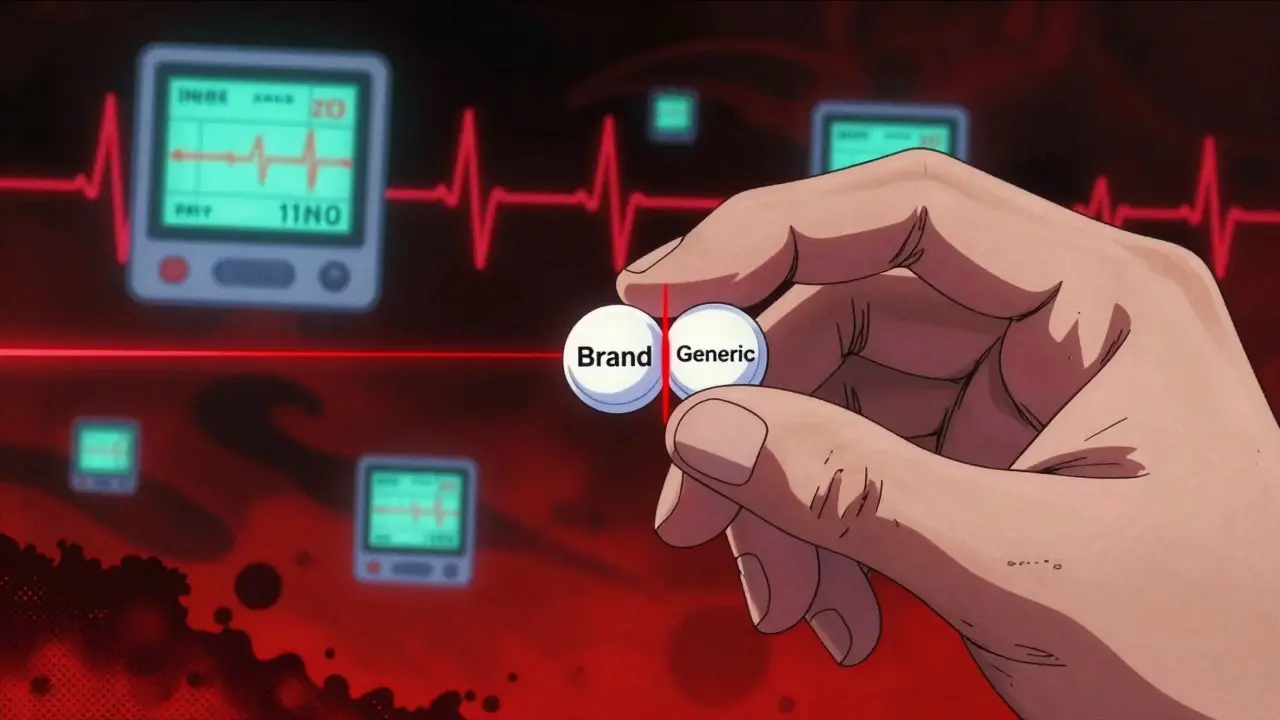
When a drug has a NTI-Narrow Therapeutic Index-it means the difference between a dose that works and one that harms is razor-thin. A little too much, and you risk toxicity. A little too little, and the treatment fails. Drugs like warfarin, phenytoin, digoxin, and levothyroxine fall into this category. For patients relying on these medications, switching from brand to generic isn’t just a cost-saving move-it’s a high-stakes decision. That’s why regulators around the world treat NTI generics differently than regular generics. And those differences matter.
What Makes NTI Generics So Different?
Not all generics are created equal. For most drugs, regulators accept bioequivalence ranges of 80% to 125%. That means the generic must deliver between 80% and 125% of the active ingredient compared to the brand-name version. But for NTI drugs, that window shrinks. The FDA tightened its standards in 2010, requiring bioequivalence limits of 80% to 125% or tighter. In practice, that often means 90% to 111%. Even small shifts in absorption can lead to dangerous outcomes. A patient on warfarin might clot if the generic delivers too little, or bleed if it delivers too much. That’s why the FDA also enforces stricter quality control: assay limits for NTI generics are 95% to 105%, compared to 90% to 110% for other drugs.
These aren’t arbitrary numbers. They’re based on decades of clinical data. Dr. Janet Woodcock, former head of the FDA’s drug evaluation center, made it clear: "For NTI drugs, we apply tighter limits because patient safety can’t afford compromise."
How the U.S. Handles NTI Generics
The U.S. system is built around the FDA’s Office of Generic Drugs. Since 2010, they’ve issued over 100 drug-specific guidance documents for NTI products. Each one outlines exact testing protocols-what dissolution profiles to use, how many healthy volunteers to enroll, and which statistical methods to apply. Healthy volunteers are preferred over patients because you want to isolate formulation differences, not individual metabolism.
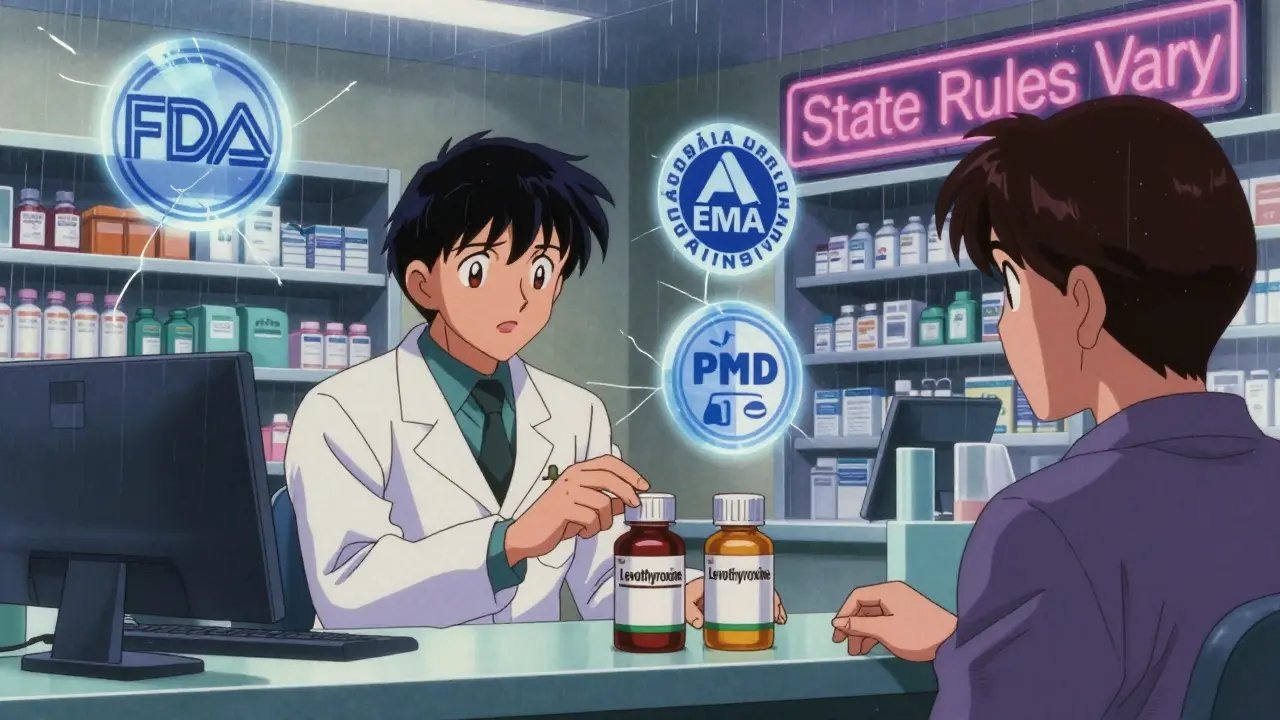
But regulation doesn’t end at approval. Substitution rules vary by state. In North Carolina, a pharmacist can’t swap an NTI generic without explicit consent from both the prescriber and the patient. Connecticut, Idaho, and Illinois require extra warnings for anti-epileptic drugs. As of 2023, 26 states have special rules for NTI substitution. This patchwork creates confusion. A 2019 survey found that 67% of U.S. pharmacists get frequent requests from doctors to avoid substitutions-especially for levothyroxine and warfarin.
And yet, when substitutions are done right, they work. A 2021 study tracking 12,500 patients across 15 European countries found that 94.7% had equivalent clinical outcomes after switching to approved NTI generics. The key? Strict bioequivalence standards and consistent monitoring.
Europe’s Fragmented but Strict System
In Europe, the European Medicines Agency (EMA) offers three pathways: the Centralized Procedure, National Procedure, and Mutual Recognition. The Centralized Procedure, which leads to approval across all EU member states, is becoming more popular. In 2022, 68% of new generic applications used it-up from 42% in 2018. This shift reflects growing recognition that harmonization reduces risk.
But even within the EU, rules aren’t uniform. Countries like Spain require the first generic to be priced at least 40% below the brand. Subsequent generics must match or undercut that price. This creates fierce competition, which drives down costs-but also pressures manufacturers to cut corners. The EMA doesn’t set prices, but it does enforce strict bioequivalence criteria similar to the FDA’s: tighter than standard, with additional requirements for dissolution testing and stability data.
European pharmacists face their own challenges. A 2022 survey by the European Association of Hospital Pharmacists found that 58% were confused about substitution rules across borders. A generic approved under the Decentralized Procedure in Germany might not be automatically accepted in Poland. That inconsistency leads to hesitation-and sometimes, patients staying on expensive brand drugs.
Canada, Japan, and the Global Patchwork
Canada takes a pragmatic approach. It allows foreign-sourced reference products for bioequivalence studies, as long as they match the local brand in solubility, formulation, and physicochemical properties. This flexibility helps manufacturers avoid costly re-formulations. Japan’s PMDA has detailed guidelines for topical NTI drugs, a category that’s notoriously hard to replicate. The U.S. and Japan are among the few countries with formal guidance for these complex products.
But many countries lack clear rules. Brazil, Mexico, Singapore, and South Korea have minimal guidance for NTI generics. That creates risks. A product approved in one country might not meet the standards of another. This is why the International Generic Drug Regulators Pilot (IGDRP), launched in 2012, matters. It includes regulators from the U.S., EU, Canada, Japan, Switzerland, Singapore, South Korea, and Taiwan. Their goal? Align testing methods, data requirements, and approval timelines.
Costs, Timelines, and Industry Realities
Developing an NTI generic isn’t cheap or fast. It typically takes 18 to 24 months and costs $5 million to $7 million-double the time and cost of a standard generic. Why? More bioequivalence studies. More dissolution testing. More stability trials under stress conditions. One manufacturer told me they ran 14 different dissolution profiles before submitting their application. That’s not unusual.
And rejection rates are higher. In 2022, the FDA rejected 22% more NTI generic applications than non-NTI ones. Most failures came down to bioequivalence. A product might pass in one study but fail in another due to slight differences in excipients or manufacturing processes.
That’s why experts recommend early engagement. The FDA’s Complex Generic Drug Product Development Meetings and EMA’s Scientific Advice sessions can cut approval time by 30 to 45 days. Skipping them is like flying blind.

What’s Next? Harmonization and New Methods
The future of NTI generics lies in better science and more cooperation. In 2023, the ICH adopted M9, a guideline that simplifies bioequivalence testing for drugs with known solubility profiles. This could reduce the need for expensive clinical trials in some cases.
The FDA is also moving toward population bioequivalence by 2025. Instead of testing 24 healthy volunteers, they’ll use modeling to predict how a drug behaves across diverse populations. This could make approvals faster without sacrificing safety.
Meanwhile, the EMA is pushing more generics into the Centralized Procedure. The goal? One standard, one approval, one set of rules across Europe. The U.S. is watching closely. Dr. Jessica Greene of the University of Minnesota predicts international collaboration through the IGDRP will cut NTI approval times by 25-30% over the next decade.
Why This Matters to Patients
At the end of the day, this isn’t about regulators or manufacturers. It’s about patients. A woman on levothyroxine who suddenly feels fatigued after a generic switch. A man on warfarin whose INR spikes after a pharmacy substitution. These aren’t hypotheticals. They’re real, documented cases.
NTI generics can be safe. They can be affordable. But only if every step-from development to dispensing-is handled with precision. The best regulatory systems don’t just approve drugs. They protect lives.





Lou Suito
February 24, 2026 AT 03:44Joseph Cantu
February 24, 2026 AT 06:58Lisandra Lautert
February 25, 2026 AT 05:39Gwen Vincent
February 27, 2026 AT 00:17Valerie Letourneau
February 27, 2026 AT 13:34Khaya Street
February 28, 2026 AT 17:06Christina VanOsdol
March 2, 2026 AT 01:11Alfred Noble
March 2, 2026 AT 14:29Matthew Brooker
March 2, 2026 AT 16:19