

Telepharmacy Safety & Knowledge Quiz
Loading question...
Quiz Complete!
You scored 0 out of 5.
Great job reviewing the key findings on telepharmacy safety.
Imagine living two hours from the nearest pharmacy. You need a complex prescription adjusted for your blood thinner, but driving that distance is a logistical nightmare. This isn't a hypothetical scenario; it's daily reality for millions in rural areas. Enter telepharmacy, the delivery of pharmacy services through telehealth technology to provide medication management remotely. But does trading face-to-face interaction for video calls compromise safety? That’s the billion-dollar question-literally, given the market size.
The short answer from current research? It’s complicated, but promising. Studies suggest that while telepharmacy doesn’t magically eliminate all risks, it maintains safety standards comparable to traditional pharmacies in most metrics. In fact, for specific populations, it might actually save lives by closing the gap between prescription and care. Let’s break down what the data really says, cutting through the hype to look at hard numbers and real-world outcomes.
Defining Telepharmacy and Its Core Models
To understand the safety implications, you first need to know what we’re talking about. Telepharmacy is not just sending an email to a pharmacist. It involves video conferencing, electronic prescription processing, and remote verification systems. The practice formally emerged around 2010-2012 as states began crafting specific regulations, with North Dakota leading the charge back in 2001.
There are two main ways this works:
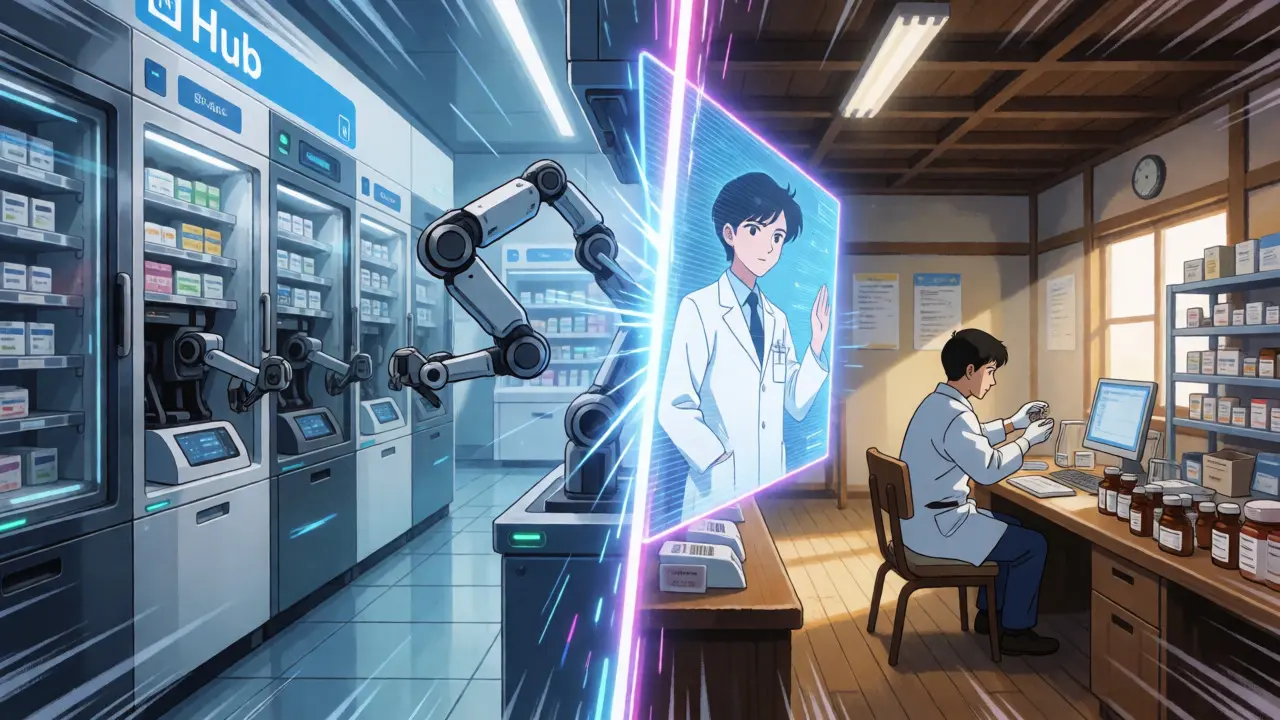
- Hub-and-Spoke Systems: A central pharmacy (the hub) oversees multiple remote sites (spokes). Technicians at the spoke site handle physical tasks, while pharmacists at the hub verify prescriptions via video link.
- Direct-to-Patient Services: Pharmacists interact directly with patients remotely without necessarily managing a physical dispensing location nearby.
These models rely on robust technical infrastructure. We’re talking high-definition video (minimum 720p resolution), secure data transmission meeting HIPAA standards, and automated dispensing cabinets. If the tech fails, the safety net frays. A study by Urick published in JAMA Network Open in 2023 highlighted that reliable connectivity is non-negotiable for maintaining these safety standards.
What Do Safety Metrics Say?
Here is where the rubber meets the road. Does telepharmacy lead to more mistakes? A systematic review by Pathak et al., published in the Journal of Health Care for the Poor and Underserved in May 2021, analyzed six studies conducted between 2010 and 2020. The findings were reassuring for skeptics.
The review found no statistically significant difference in overall medication safety outcomes between telepharmacy and traditional models. Both achieved medication error rates below 1%. Specifically, telepharmacies demonstrated dispensing accuracy rates of 99.2% to 99.8%, which is nearly identical to the 99.3% to 99.9% seen in brick-and-mortar pharmacies.
However, context matters. The same review noted that telepharmacy reduced after-hours drug approval times to 14-20 minutes, compared to much longer waits in traditional settings. Faster approvals can mean quicker treatment initiation, which is a safety win in itself. Yet, the authors cautioned that methodological limitations in the studies, such as inconsistent error tracking, prevent us from declaring absolute equivalence.
The Rural Access Advantage
If safety parity is the baseline, access is the differentiator. For rural communities, the absence of a pharmacy is a safety hazard in its own right. Patients often skip doses or delay refills because the nearest provider is too far away.
Urick’s 2023 study provided compelling evidence here. States that implemented pro-telepharmacy policies saw a 4.5% relative decrease in "pharmacy deserts" within one year. Even more striking, there was an 11.1% reduction in the population living in these deserts. By bringing expertise to underserved areas, telepharmacy addresses critical access issues without sacrificing quality.
| Metric | Telepharmacy | Traditional Pharmacy | Source/Notes |
|---|---|---|---|
| Dispensing Accuracy Rate | 99.2% - 99.8% | 99.3% - 99.9% | Pathak et al. (2021) |
| Medication Error Reduction | ~15-20% in some studies | Baseline | Varies by implementation |
| Hospitalization Increase (2020) | +12.9% | +40.2% | Retrospective cohort study (2021) |
| Patient Satisfaction | 76.4% High | N/A (Contextual) | Int. J. Telemedicine & Apps (2022) |
Hidden Risks and Limitations
It’s not all sunshine and seamless video calls. There are legitimate concerns that the data hasn’t fully resolved. One major issue is the loss of non-verbal cues. Dr. Jerry Fahrni, writing in the Journal of the American Pharmacists Association in September 2022, pointed out that physical presence allows pharmacists to detect subtle signs of medication misuse or adverse reactions. Can a webcam pick up on a patient’s slight tremor or confusion? Not always.
Technical glitches also pose risks. A Reddit thread from April 2023 documented a user in North Dakota whose insulin allergy was missed during a consultation because of poor video connection. This led to an adverse reaction. While rare, such incidents highlight that technology reliability is a direct safety factor.
Furthermore, training gaps exist. Research cited in Perspectives (2016) found that pharmacy students performed consultations 15-20% less effectively via telepharmacy compared to face-to-face interactions. This suggests that unless pharmacists receive specialized training-which guidelines from the American Society of Health-System Pharmacists recommend should be 16-24 hours-the quality of counseling may drop.

Real-World Implementation Challenges
Setting up a safe telepharmacy system isn't plug-and-play. It requires rigorous protocols. Successful implementations, like the Indian Health Service program serving Navajo Nation communities, have established dual verification processes for high-risk medications. Their result? A medication error rate of 0.45%, significantly lower than the national average of 0.67%.
Key challenges include:
- Connectivity: 35% of telepharmacy sites reported problems with secure video connections in a 2022 survey.
- Emergency Handling: Managing acute situations remotely requires clear transfer-to-in-person protocols.
- Identity Verification: Ensuring the person on screen is actually the patient prescribed the medication.
A pharmacist working in a South Dakota hub noted in Pharmacy Today (August 2022) that they catch about 1.2 errors per 100 prescriptions remotely. This is comparable to traditional rates, but complex cases still require transferring care to a physical location. The system works best when it knows its limits.
The Future of Telepharmacy Safety
The industry is moving fast. The global telepharmacy market was valued at $1.87 billion in 2022 and is projected to hit $6.84 billion by 2030, growing at a CAGR of 17.3%. With this growth comes increased scrutiny and better tools.
New technologies aim to close the safety gaps. Companies like MedsAI are developing AI-powered tools to predict adverse drug events, showing an 18.7% improvement in early trials. Additionally, the Patient-Centered Outcomes Research Institute awarded a $3.2 million grant in 2022 for a randomized controlled trial comparing safety outcomes across 12 rural communities. This higher-quality evidence will likely settle many of the current debates.
Regulatory bodies are also stepping up. The FDA’s Sentinel Initiative launched a monitoring project in January 2023 specifically to track adverse events linked to telepharmacy. Meanwhile, the American Pharmacists Association aims to establish evidence-based safety standards by 2025. These steps signal a maturing field where safety is being prioritized alongside expansion.
Is telepharmacy safer than traditional pharmacy?
Current studies show no significant difference in overall safety outcomes. Dispensing accuracy rates are comparable (over 99% for both). However, telepharmacy may reduce hospitalizations in certain contexts due to improved access and faster approval times.
What are the biggest risks of using telepharmacy?
The primary risks involve technical failures, such as poor video quality leading to missed information, and the inability to observe non-verbal cues. There is also a risk of inadequate training for staff new to remote consultation methods.
How do I know if my local pharmacy uses telepharmacy?
Check with your local pharmacy or state board of pharmacy. Many rural hospitals and independent pharmacies in designated shortage areas now offer these services. Look for terms like "remote verification" or "virtual counseling."
Does insurance cover telepharmacy services?
Coverage varies by state and insurer. As of late 2022, Medicare Part D expanded reimbursement for telepharmacy services. Private insurers are increasingly following suit, especially for chronic disease management.
Can telepharmacy handle complex medication regimens?
Yes, but with caveats. Complex cases often require a hybrid approach where initial assessments happen remotely, but physical exams or lab reviews trigger a referral to in-person care. Protocols usually dictate when to switch modes.






Stuart Lorne
August 31, 2026 AT 22:55its all smoke and mirrors really the data is cherry picked to sell tech stocks you cant replicate a human touch with a webcam no matter what the studies say its lazy healthcare for people who dont care about quality
Anderson Miller
September 2, 2026 AT 01:28Lazy?? Really? That's a bold claim without any actual evidence to back it up. You're dismissing a decade of research because you prefer face-to-face interactions. It's not about laziness, it's about accessibility for those two-hour drives. The error rates are comparable, so your argument falls apart unless you have specific counter-data which you seem to lack.
Stuart Lorne
September 3, 2026 AT 22:08counter data? i lived through the north dakota pilot program and saw missed allergies firsthand technology fails humans dont stop caring just because theyre behind a screen you think a 99% accuracy rate means nothing when that 1% kills someone? naive
Morgan Law
September 5, 2026 AT 05:07Hey everyone 👋 Just wanted to chime in as someone who works in rural health admin! 🌾 This article hits the nail on the head regarding access. For my community, 'safety' isn't just about error rates, it's about whether the patient gets the meds at all. If we didn't have telepharmacy, half our seniors would be skipping doses entirely. That's a bigger safety risk than a potential video glitch IMO. 📉➡️📈 Keep pushing for better connectivity though, that's definitely the weak link right now. 💻🔌
Aaron Gragg
September 5, 2026 AT 06:21The distinction between hub-and-spoke models versus direct-to-patient services is paramount here; conflating them leads to erroneous conclusions regarding liability and clinical oversight. Furthermore, the regulatory landscape remains fragmented across state lines, creating a patchwork of standards that complicates the generalization of these safety metrics. One must consider the socioeconomic determinants of health that drive the adoption of these technologies in the first place.
Kimberly Thomas
September 5, 2026 AT 12:07You're missing the point completely. It's not about the model, it's about the training gap. Students are 15-20% less effective remotely. That's huge. And nobody talks about how hard it is to verify identity when grandma looks different on a grainy feed. Stop pretending this is equivalent until the training catches up.
Sarah Leitschuh
September 7, 2026 AT 11:46I appreciate the passion here, but let's look at the Indian Health Service example mentioned in the post. They achieved a 0.45% error rate. That's lower than the national average. So clearly, with proper protocols, it works. Maybe instead of focusing on what's wrong, we can focus on scaling what's working? We need more hybrid approaches rather than an all-or-nothing debate. It's complicated, sure, but giving up on progress helps no one.
kishhore kumar
September 8, 2026 AT 22:07interesting perspective!!
but does anyone know if the AI tools like MedsAI are actually FDA approved yet or still in trials? seems like a big leap from prediction to prescription approval. also curious how this impacts insurance costs for middle class families not in rural areas :) maybe they pay more for convenience?
Marshall Stephens
September 9, 2026 AT 16:33Most private insurers are following Medicare's lead on reimbursement, so costs might stabilize soon. As for the AI, it's mostly assistive right now, helping pharmacists flag issues, not making final decisions. Still early days but promising for catching interactions humans might miss during busy shifts.
Rose Boerner
September 11, 2026 AT 13:37It is frankly appalling that we are even debating this as if it were a novel concept. The moral imperative to provide care to the isolated and elderly outweighs the minor inconveniences of technological glitches. To suggest otherwise is to privilege urban convenience over rural necessity. We must hold providers accountable for robust infrastructure, not abandon the vulnerable to logistical nightmares. The data supports the expansion, and ethics demands it. Period.
Kristina Rhodes
September 12, 2026 AT 13:54There is a profound philosophical shift happening here, moving from physical presence to digital trust. While skeptics worry about the loss of non-verbal cues, perhaps we should view this as an opportunity to redefine empathy in healthcare. Optimism suggests that technology, when wielded with care, extends our reach rather than diminishing our connection. Let us encourage this evolution, supporting those who navigate these new waters with grace and diligence. The future of care is hybrid, and that is something to celebrate, not fear.
Adam Cox
September 12, 2026 AT 17:51Great post. But seriously, who checks their blood thinner dosage via Zoom? My aunt tried it and ended up double dosing because she couldn't hear the pharmacist properly. The tech isn't ready for complex regimens. Simple refills? Sure. Complex adjustments? No thanks.